Ep 004: Just Start and Then Adapt as You Go – with Courtenay Hartford
Watch the Interview
Listen to the Episode Below
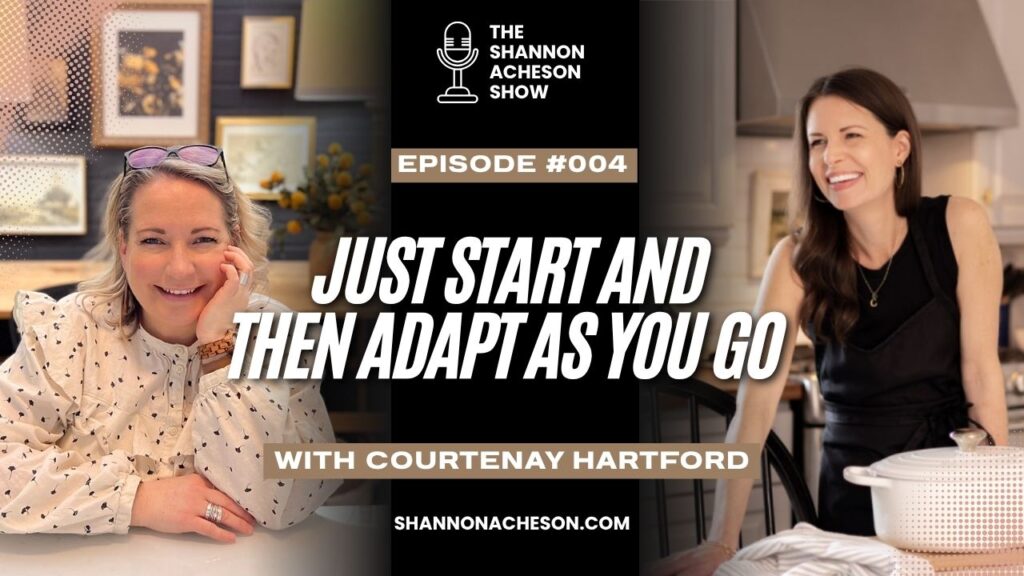
In this episode of The Shannon Acheson Show, I sat down with my longtime friend and fellow home blogger Courtenay Hartford of Creekline House and Art & Spaces Photography. We talked about how she went from documenting farmhouse renos “just for fun” to running two separate (and successful) businesses—without chasing trendy growth tactics or selling her soul to the algorithm.
Courtenay shares what it looked like to start small, let things evolve, and carve out a niche that didn’t even exist yet. She talks about the 25-cent moment that changed everything, how she set boundaries early, and why she ditched “perfect” content in favor of real connection. Whether you’re just starting or ready to pivot, this one’s packed with perspective shifts and solid, sustainable advice.
Key Points from This Episode
Courtenay started Creekline House in 2011 after being inspired by other home decor blogs and wanting to document her own farmhouse renovation journey.
She didn’t originally intend to turn it into a business—but seeing ad revenue (even $0.25 while watering the garden) helped her realize the potential.
Her business is now split 50/50 between her blog (with ad income) and her interior styling/photography business, Art and Spaces.
She launched Art and Spaces after noticing a gap: great craftsmanship wasn’t being captured well in photos, especially for cabinet makers and home builders.
Art and Spaces offers a unique combo of styling and photography, which sets them apart and solves a big pain point for busy clients.
Courtenay’s blog and client work stay mostly separate, with different audiences and very little crossover.
She sets strong boundaries by offering limited shoot dates and sticking to a 10 a.m. start time—clients adapt, and it makes life more sustainable.
Casual iPhone photos have a place, even for a professional—connection often beats perfection.
They originally thought product photography would be their main service, but it turned out to be draining and less in-demand—so they pivoted to interiors.
Her best advice for creatives starting out: just start, and then adjust based on what works. You won’t know what works until you try.
Quotable Moments
“I made 25 cents to water my garden… and I was like, oh my gosh — that’s amazing. That’s proof that real people are reading this.”
— Courtenay Hartford, 05:39
“The impression from the outside is that the photography business is a real business… and the website is a play business. But it’s 50/50.”
— Courtenay Hartford, 07:10
“We figured out pretty quickly that what works for us is not ‘what works for you,’ but rather, ‘here are the dates we’re available — pick one.’”
— Courtenay Hartford, 22:20
“Just start. You can’t be fully prepared or know what the outcome will be… the income opportunities will reveal themselves.”
— Courtenay Hartford, 35:39
“There’s a 90% chance the thing you think will make it work is going to flop — but something else will catch.”
— Courtenay Hartford, 37:20
“If there’s a chocolate cake across the room and you really want it… you’ll come up with all kinds of creative solutions to get there.”
— Courtenay Hartford, 39:07
“All businesses are creative businesses… the ones that succeed incorporate creativity.”
— Courtenay Hartford, 40:53
About Courtenay
Courtenay Hartford is the author of creeklinehouse.com, a blog based on her adventures renovating a 120-year-old farmhouse in rural Ontario, Canada. On her blog, Courtenay shares interior design tips based on her own farmhouse and her work as founder and stylist of the interior photography firm Art & Spaces. She also writes about her farmhouse garden, plant-based recipes, family travel, and homekeeping best practices. Courtenay is the author of the book The Cleaning Ninja and has been featured in numerous magazines, including Country Sampler Farmhouse Style, Better Homes and Gardens, Parents Magazine, Real Simple, and Our Homes.
Links Mentioned in This Episode
Creekline House (Courtenay’s blog):
https://www.creeklinehouse.com
Art and Spaces Photography:
https://www.artandspacesphotography.com
Creekline House on Instagram:
https://www.instagram.com/creeklinehouse
Art and Spaces on Instagram:
https://www.instagram.com/art_and_spaces
The Cleaning Ninja (Courtenay’s book):
https://www.amazon.ca/Cleaning-Ninja-Household-Cleaning-Effortlessly/dp/1624144745
VIDA (the Canadian outdoor product company Courtenay is working with):
https://www.vida.ca
Take the free ‘Which Business Style is Right for You?’ quiz:
https://www.shannonacheson.com
00:00
you
00:04
Welcome to the Shannon Acheson Show, real business talk for real life. I’m Shannon, creative business coach, digital product lover, and your strategy sidekick. I’ve built a business that fits my life, and now I help other women do the same. No hustle, no fluff, just smart, honest conversations about building a business that works for you. Let’s dive in.
00:30
Today on the show, I am so excited to have Courtenay Hartford on here. I’m gonna read her bio just by way of introduction, and then we’re going to chat and just talk all things business and online stuff. Courtenay Hartford is the author of Creekline House, a blog based on her adventures renovating 120 year old farmhouse in rural Ontario, Canada. On her blog, Courtenay shares interior design tips based on her own farmhouse and her work as founder and stylist of the interior photography firm, Art and Spaces.
00:59
So cool. She also writes about her farmhouse garden, plant-based recipes, family travel, and homekeeping best practices. Courtenay is the author of the book, The Cleaning Ninja, and has been featured in numerous magazines, including Country Sampler Farmhouse Style, Better Homes and Gardens, Parents Magazine, Real Simple, and Our Homes. Welcome to the show, Courtenay. I’m so excited to have you here. Thank you. Thanks for having me. So you started Creekline House, if I’m not wrong, in about 2011? Yes. Yeah. Sort of…
01:29
How did you get started with that and sort of what’s kept you going with that all these years? Because now that’s like 14 years later. Yeah. Well, so it was around like 2010 or so. Home decor blogs were starting to get really popular and I just really enjoyed reading them and something about them.
01:49
I’m sure yours was one of them actually. When did you start? I started the year before, 2010. Okay, so I’m sure I stumbled upon yours at some point, but I was just really inspired by the whole concept and something about it just made me think like I wanted to be a part of that. So when we bought this house in 2011, I just like basically a week before our closing date, I started this blog just for fun, just to see if I could do it.
02:19
for the document, what you’re doing? Pardon? Was it sort of to document a little bit what you were doing to you on the house? like I thought it would be a really like a neat project and interesting to read about because we came from just a regular townhouse in the like the outskirts of Toronto. So moving out, like leaving the city, moving to the country, old farmhouse that needed like a ton of work. I thought it could be really interesting.
02:48
Yeah. And of course, like the renovating of the house, as well as the writing of the blog was way more work. And there was way more involved than I ever realized, which is always the case. Right. But I loved it. Yeah. Yeah. And it turned out people were reading it. So I just kind of kept going. Yeah. Here we are. It’s just like it’s become such an ingrained
03:17
daily practice, like all the different forms of content that I do, like writing in blog posts and like Instagram, social media, all that stuff. It’s just like, it’s my way of life at this point. Right, after 11 years or after 14 years. Yeah, for sure. And was there, so did you start it with the intention of making it like be a business? Like, cause I know back, like back then when we started, there were blogs that were like,
03:47
just for the sake of blogging and documenting and sharing with family. And there are blogs that deliberately started as a business. Where did you fall in that and then, yeah, from there? I don’t know if I was even aware that blogs were businesses at that point. Okay. So what changed? When did that sort of shift? What did you sort of, how did that? It’s funny because I remember this specific moment.
04:14
where I was working away, like I worked at it, almost like it was a side business, side hustle, I guess. So I worked at it consistently every day and I took it seriously, but it was just like, I took it seriously because I enjoyed it so much. And there were like ad networks starting to be more popular, starting to come out. So there was, I got on an ad network.
04:42
Um, and this particular one at the time, like, track your earnings, like on a minute to minute basis. You could, you could like walk away from your computer and then come back and see what you’ve made in the last five minutes. it would pop like seven cents made and whatever. Right. Yeah. Um, so I went out to the garden at some point, I stopped working. went out to the garden and watered my garden.
05:12
Um, for 15 minutes or something. And then I came back in and I checked my earnings because it was just like a fun little game. Right. Yeah. How do you resist checking that a million times a day? Yeah. And I’d made 25 cents to water my garden. And I was like, Oh my gosh. That’s amazing. First of all, that’s proof that real people are reading this, um, and finding me somehow and maybe checking back in after discovering me the first time. Right. Um, but also.
05:43
It sort of made me think maybe there was some money making potential. Right. though 25 cents is like… Yeah, but I mean, you were doing something you needed to do anyways. You were going out to water the garden and your blog was making even 25 cents. Like when you hadn’t really thought about it, I guess, before. That’s a big deal. a big turning Passive income. Right, right. Passive quarter. Right, a passive quarter. Still, a quarter’s a quarter. Yeah.
06:12
So between blogging, content creation, and now photography and styling, how does your business actually work? Like what are the ways, because I know, I’m pretty sure you have ads on your website, you do the art and spaces. That’s right, right? Yeah, art and spaces. So how does your business sort of look like? Where does your income come from? You don’t have to give me like amounts or anything like that, how does that all fit together? Because it’s really at this point kind of like 50-50.
06:42
Okay. So like the website is like one entity that’s about 50%. And then the photography business, art and spaces is its own thing. And it’s another 50%. Okay. It changes month to month. But yeah, for sure. But like, it’s, it’s funny because the impression I think from an outside viewpoint is that the photography business is a real business. That must be
07:12
like where we make most of our income. And then the website is like a play business. But it’s 50-50-ish. It’s 50-50-ish, yeah. That’s amazing. That’s awesome. That’s great. What inspired you to launch Art in Spaces to begin with? Like, was it a natural extension of what you’re doing or was it, did it feel like a full, like a pivot, like completely separate? I guess it was a bit of a natural extension in that the photography skills.
07:41
and the styling and that kind of thing had been developed through website work. Right. Or were developing, I guess, because I wouldn’t say I was an expert or like I was not an expert at the time. And I wouldn’t even say that I’m necessarily an expert now. pictures are really pretty. Thank you. I don’t know. I looked at them. I was like, wow. It’s a constant. Oh, yeah. right? And like there’s constant growth there.
08:11
But it just kind of came about through like conversations with friends who were also on social media. And we would kind of look at different local businesses, like cabinet companies, home builders. And we always found it really like funny and frustrating. I don’t want to say bad the photos were, but how… Not good? Yeah. Like how you could tell that…
08:41
there were these local businesses that were doing some amazing work. Right. But it just wasn’t coming through in the photos that they were sharing on Instagram and on their websites. And we were like, I can tell that’s a beautiful kitchen, but can someone please just clear the clutter and stick a plant in it and like light it properly. And then that would make all the difference. it was just like, just, wanted to make it right. Just because.
09:10
No, that’s fair. no, that’s fair. And so it was kind of a matter of me thinking, like, I wonder if anyone would be willing to let us come in and take some photos. Like, want like pie in the sky dream. I asked someone and said we were a business if someone would let us come in. kind of thought it would be
09:36
Like maybe if we were lucky, once a month we might get to go do one of these fun projects and go into one of these beautiful homes and kind of play around, fix it up a little bit, photograph it. Yeah. Properly. Yeah. Properly like in our eyes. Right. And then it turned out like, yes, there was a huge demand for that. so it just kind of, grew from there.
10:01
Right. there is this, like when you talk about like growing and learning and like in photography and styling and stuff, that takes a while to sort of to hone those things. Right. Like if I go back and look at my own old blog pictures, I’m like, oh my gosh, what was I thinking kind of thing. Right. Like just you grow over the years. But then there’s a difference, I think, between like you said that they do beautiful work, like these cabinet cabinet makers and stuff, and they’ve done beautiful work. But there’s a difference between it being beautiful in person.
10:29
and showing it well in pictures, right? Like there’s angles and there’s lighting and there’s just so much. And so I think it’s amazing that you saw that and sort of put that out there. Like you saw a need somewhere and put that out there as a business idea. Like that’s the best way to go about creating a business, right? Like you see a need and you can fill that need. It was so funny because our business is quite unique. So again, that was another crazy idea where
10:59
I thought maybe they’ll let me come in and style it and take pictures, which no one was doing or is really doing. Like typically styling and photography are two different things. So for us to say like, a home builder, like, hey, we’ll come in, we’ll bring the styling, we’ll do everything. We’ll take the photos. All you have to do is send us an address and a date and we’ll be there. You’ll get a beautiful gallery of photos.
11:28
So that has been a really great service for people who just don’t have time. Because these people are busy. Yeah, I bet. Oh yeah. They don’t have time to fiddle with styling and trying to get the perfect shot. And trying to even line up someone who’s going to style it and then someone who’s going to photograph it. That’s two different appointments usually and two different, right? That’s a lot of scheduling. And I think you found a really amazing niche for that, especially
11:57
for the people like, that was my next question is who do you work with through there? So you said home builders and cabinet maker. Cabinet makers, like a lot of designers. Okay. mostly designers. Okay. And like, I will, I’ll do the styling for anyone who wants it done. Right. Because I’m not gonna send them boring or ugly photos. Right, right. Photos and spaces that look.
12:28
unengaging. Yeah. So basically, someone’s got to do it. So a lot of the designers we work with have an interest in doing their own styling, they have a vision, it’s the project is their baby. So right, they’ve been kind of envisioning this since the start. So they’ll come in and style it. And it’s beautiful. And in that case, I will just tweak the styling a little bit, depending on like every angle that you need to move everything around, everything needs to fall in the frame properly.
12:56
So I’ll do that. But otherwise, for the home builders, the cabinet companies who want nothing to do with that whole process, then we just take care of all of it. Yeah, yeah. I think that’s something that we sort of, as home bloggers in the last 15 years, we sort of fell into that, right? Like you said, was more work than you thought it would be because…
13:20
We are, we’ve done like all those different things, right? Like you and I have both, think we’ve been in the same magazines at the same time as far as projects and stuff go, but like you had to be like the person who created the thing, the person who styled it, the person who photographed it, the person who wrote about it. So like all the things. And so I think while that was a missing niche, like your art and spaces business, that was a totally missing piece for the people. I don’t know for people, for businesses everywhere, but.
13:49
where you live especially, that I think you are sort of positioned to help those people, right? Like because of what your experience has been. Does that make sense? Yeah, for sure. Yeah. Okay, so you have a very lovely style. It’s calm and cozy and livable. So how do you, do you bring some of that same vibe into the client work while still meeting their needs and matching their sort of thing?
14:17
Does your style come through in many of your styling and shoots? You know what? It really doesn’t. Okay. A lot of the projects that we shoot are super modern. Okay. So not always, but a lot of them are just because that’s what’s happening right now. It is, you’re right. In the design world. Yep. So it’s almost like Art in Spaces has a style of its own. Okay. Yeah.
14:47
And it’s quite different from my own personal style. Okay. Which is fun because I can really get that, like I get my modern fix. Right. Yeah. I enjoy it. It’s a new challenge. It’s something different. Yeah. I feel like, I feel like I like a lot of different styles, but I don’t want them all in my house. So I would imagine it’s the same. you like them and enjoy them, but
15:15
not in your own house, but this way you get to sort of play with both or all of them. totally. Oh, that’s awesome. Okay. How has running the blog helped your other business grow? Like does it, do they sort of, does it bring you leads or visibility? Like is there a crossover ever do you think? Like do people come to Art in Space and say, found you because I found Creekline House or does Art in Spaces sort of bring its own separately? Yeah, it’s definitely.
15:44
Like people are hiring art and spaces because they like art and spaces. And I think in the majority of cases, those clients don’t know that Cree Client House exists. it’s a matter of, those clients do sort of come to know that I have Cree Client House and I sort of explain it like this is my personal website.
16:12
like equal in size and stature in my heart. Right. But people want to know that the thing that they’re hiring you for is the important thing, right? Yeah. I think that’s what they feel like. Yeah. So I sort of like, we work with the same clients over and over again. We have a really solid base of people that we work with. they kind of become friends over time. I see them regularly. So they start to know me personally and it comes up in conversation. Okay.
16:42
For the most part, it’s not a matter of people finding Creekline house and being like, I love your work on Creekline house. So I decided to hire you. They’re two totally different animals. Very interesting. Okay. What does a typical week look like for you now juggling both your content? So you’re saying that they’re sort of separate. I know you’re laughing now.
17:05
They’re separate. So that means like, I’m assuming that means double social media, like double email lists, double websites. Like, so what does your week look like with the online stuff, but also like, obviously, art and spaces is out in the world and you go do stuff. Like, what does your typical week sort of look like? Or is there a typical week? I think there is a typical week. I think that kind of has to be to sustain any kind of long-term success. Right.
17:35
Um, so we shoot usually two to four times a week, on the scope of the projects. Sometimes it’s just, we have a bunch of little projects. Sometimes the projects are really big. Um, and then we need to fit some time in there for editing. Um, and Chris does like all of the editing and then I’ll just look it over and give my thoughts and like suggest any tweaks at the end of the process.
18:04
That’s helpful. Chris, my husband. I was going to say Chris is your husband, right? And he like, that’s what he went to school for. He went to school for digital media arts. So he has the formal training and in all that stuff in the background. That’s helpful. So when we’re out shooting, we’re just out shooting. We’re typically on for like most of the day. Okay.
18:29
I’m and then I’m fitting in Creekline House kind of where I can. So I have a lot of early mornings for sure. Okay. Where I’m getting up and fitting in like writing my email to my email subscribers, planning social media, just trying to like bang out 500 words or so on a blog post. Right. Just to get something down and make a little progress.
19:00
I don’t really have a good explanation because I do really work all the time. Which is totally fine when you love what you do. I also, I I follow you on social so I know that you guys do stuff. You go places, you visit the city, you go antiquing, you do other things. So you’re not working all the time. This is true. Yeah.
19:29
when you own your own businesses, you have the flexibility. you can make wiggle room where you want to or where you need to. But like evenings and weekends, we’re getting things done. Like whether it’s doing styling plans for art spaces or there is no real compartmentalization to the way it works for us. We don’t have time blocks.
19:57
Okay. Anything like that. As much as I love the idea of time blocks, people say they do that. I’m like, that’s beautiful. But it’s just kind of like. It has to flow a little more and sort of adjust, right? But it like, we’ve been doing art in spaces for five and a half years now. Okay. So we’ve really, I think stumbled upon something that works for us. That’s good. You know what works for us is just working all the time. Right. early mornings.
20:26
always getting a little something done. Yeah, but if you love it, that’s it’s so different than like being forced to work like a nine to five with overtime, right? Like it’s, it’s so different that way, right? There’s a looking forward to getting stuff done. Yeah. Yes. Yeah. Rather than like a looking forward to being done or like taking time off. Yeah. Yeah. There’s, there’s excitement in the work of it and you know,
20:55
Yeah, I see what you’re saying. I know a lot of people say like Dean has Dean has been my husband has been very involved in our business all along, especially with the blog and DIY projects and stuff like that. And like our date nights will consist of talking about business stuff sometimes and people are like, oh, you shouldn’t do that. I’m like, why? that’s perfect. Right? Like it’s, it’s so much part of our life that why? Like, why not? Like why? Anyway. Okay. That’s really cool. So
21:21
What’s one thing that’s working really well for you in your business right now, whether it’s a tool, a mindset shift, or a specific type of offer or product or service? So one thing I think that has always worked well for me pretty much from the beginning, I figured this out pretty quickly, is like I think there’s a common misconception that when you run a business and you have clients, you need to fit perfectly into their schedule.
21:50
So like if you’re like meetings and shoots and things like that where you need to be present, physically present, you might be inclined to say, what works for you? Like tell me when you need me to be there. And we figured out pretty quickly that what works for us is not that, but rather saying, here are the times that we are available or here are the dates that we have.
22:21
pick one. Right. And you think that might be a problem because if you’re giving people limited dates, especially when like you’re working with multiple trades on a project, so everyone needs to be done. There’s homeowners involved who actually live in the space if you’re shooting like a residential project.
22:44
Yeah. And there’s, there’s so many moving parts, but I found if people want to work with you, it’s really like, it’s not that hard though. They’ll work. And it’s like, like once in a blue moon, someone will say none of those dates work. Right. We need a specific date and then that’s fine. But typically like nine times out of 10, 99 times out of a hundred, say, are the dates available?
23:13
That’s a really good thing to have learned. I imagine that saves a lot of juggling kids around even. If you’re saying, when do you need me? And they’re like, well, 3.30 on a Wednesday. And you’re like, I got school pickup that day or the bus or whatever. I would think that that would make a big difference in just how you run your business in general by putting those boundaries in place. Yeah.
23:43
Because in our industry, we work with clients over and over again and they just know what to expect. Right. It’s not like the schedule is not jumping all over the place. We do a 10 a.m. start time. Right. Pretty much every time. Right. it’s a special circumstance. So they know what to tell their clients. Right. It’s going to be 10 a.m. It’s going to take like they’ll be on site for four to six hours, probably for a project of this size. Right. And it’s kind of always the same.
24:12
So I think that works well. That’s really good. Yeah. And I think we’re seeing this more and more actually in different types of businesses where, like, if you think of small shops, I see a lot of independent shops that have hours that are like 10 to four. It’s true. I’m like, 10 years ago, I think I would have seen that and thought, well, I’m not available during those hours. How do you expect me to come to your business? Right. But now I see it and I think,
24:42
That’s great. Right. Yes, you’ve communicated when you’re open. If I want to go, I will all show up during those hours. True. That works for me. I can make it work. Right. Yeah. Yeah. There are some local stores down. I live in sort of near like just outside Bowmanville, Oshawa area. And Bowmanville has that downtown. Some of my favorite places, they’re like, well, we’re only open 10 to 3 and we’re not open Mondays or whatever. And I’m like, well, that kind of sucks because I always want to go after the weekend. But whatever. I’ll go because I like it. Right.
25:12
And that just makes it so much more sane for them as a business owner to do it. And I think, I mean, I kind of did the same thing when I was booking podcast interviews. I’m like, well, I these days, tell me if it really doesn’t work, but otherwise this is when, right? Like, so I think that’s an important thing to do even as a business owner, if you’re starting out or pivoting to a new business thing, a new business model is to make sure you know when you’re sort of
25:39
good to do things in your personal schedule, in your sort of energy levels or whatever, right? Like to make sure that you’re not overburdening yourself with, I’m just available all the time, right? Because it’s so tempting to do that. You feel like you have to, but you really don’t. You really don’t, no. And it’s better for the long-term sustainability. Yeah. Like your clients want you to exist as a business because they need you. So it’s better for everyone if everyone is happy and it works long-term.
26:09
So you don’t burn out and then, yeah, yeah. Excellent, excellent. Okay, what’s something that you used to spend so much time on that you’ve let go of and don’t miss one bit? This is so funny because art and space is all about perfect photos. But I think in Creek Linehouse, I used to spend a lot of time trying to make all of my content perfect.
26:38
visually perfect. On like on social media, on the blog, I thought every photo had to be like the most inspiring thing. Right. And that’s sometimes not possible, sometimes not necessary. And also sometimes not better. It’s true. Then imperfect. Like it’s true. It’s you have to have confidence in your viewership that they know the difference between
27:08
an iPhone photo that’s taken quickly and casually, right? They can tell the difference. Um, and they see that there are the super polished photos taken professionally lit properly. And those like they serve different purposes. do. But I think like a phone photo is like a point of connection almost as they feel like it’s, it’s real and they’re seeing kind of the behind the scenes. Yeah. Um, so
27:38
Casually throwing in iPhone photos even to like blog posts, right? Has been such a relief to me and even like to Instagram. I think we were all doing it It was so polished and so like grid perfect for a long time, right? like 2017 2018. Yeah, you’ve got you felt like you had to yeah, but Like a little a little bit of imperfection goes a long way and and now I even tell
28:08
my, like our photography clients, um, with reels and stuff like that. Sometimes people ask us like, can you make me a reel? Because we can, we have video capabilities, obviously, so we can do that. But I often just tell them like, the magic is in the mix. So I care a casual photo or a casual video taken with your phone, right? On like on set or just behind the scenes and pair that with the polished photos. Right.
28:38
And that’s where you’ll really get the engagement because people understand the behind the scenes and then the wow after a big reveal moment. Right. Which maybe doesn’t sound like good business because we can make money if we charge people to make videos. No, but I think a little bit, I’ve had people say to me, can you just show how real, like, your house, like, for the personal side of things, my blog, like, does your house always look like it does in the style of pictures? like…
29:03
No, we live here. I think sharing a little bit of that helps you be relatable to people a little bit. And I think also helps them feel better that even with the styled amazing photo shoots, I think it’s not gonna stay that way after someone moves in or someone lives there, right? It’s going to be a little more casual, even the most beautiful spaces. People just wanna know there’s a little bit real there too, right?
29:33
Right, okay. I love that because I’ve done the same thing. I have, truthfully, on my blog, my personal blog, I have not used my big camera for a long time. I’ve cheated and used iPhone pictures for a long time now. Like, %? Yeah, 100 % for probably three or four years. have not picked up my actual camera. No.
29:59
You are a rebel. You are a full rebel. just, you know what? had to always use a tripod because I guess I have a little bit of just enough of a shake that I could never get a still clear picture without using the tripod. Of course, you have to use a tripod. Right. And so I just got lazy. Excuse me. And stopped using it and bought like the iPhone with the best camera and just started using that. So I haven’t, truthfully myself, haven’t used my camera for.
30:29
a long time. Well, yeah, we’re yeah, sorry. You can think less is less of me now. That’s okay. it’s two totally different things. And yeah, not trying to sell. No, I’m not exactly no, or things in your home or no, you’re totally different. And none of that I don’t think I’ve used. None of the iPhone photos have been used in magazines either. That’s still all camera.
30:57
Right? So there is a huge difference. They like they know and they need to know. Yeah. Yeah, exactly. Yeah. So it’s totally different. Okay. Have there been any moments where something flopped and it turned out to be exactly what you needed to grow or shift or to change something? Yes. But no, like, it’s not so much a flop. Just something that didn’t really work out. When we started Art in Spaces,
31:28
We thought that the majority of our business would be product photography. We thought that was where the need was. Like artisans, makers, like people who made things that sold at like, know, maker fairs and stuff like that. And we thought, they need to share their stuff on Instagram. They need to do Etsy listings. Like they have so many products and they would need.
31:57
to do that and we also thought that like shooting interiors would be kind of a dream. Like we didn’t think there would be much demand for that. So every once in a while we would get, we thought we would get to do beautiful interiors, but then we’d mostly end up working with smaller makers. like, obviously we were fine with that. We thought product photography seemed really simple, really straightforward.
32:27
we can actually do it in our home. can kind of set up a little like a studio setting and we thought boom, boom, boom, knock it out. But it turned out to be like all things in life, way more time consuming. Okay. When we realized. you think you’re like, you’re like, oh, just put the product down a little bit of styling, do the cube, shoot it. Okay. Next. So in your mind, you’re picturing it 30 seconds per.
32:55
product, but it’s actually like half an hour per product. Or more because maybe it’s just not working. And it’s not a matter of lighting or anything like that. You control everything, but maybe the styling isn’t quite right or just the product itself isn’t photogenic. Not that that, not that we really dealt with that, but sometimes there’s like labels that are askew when you’re trying to disguise it.
33:25
Yeah, and we would we’d get products in and they would take over our house. Because we’d have like bins and boxes of people’s stuff lined up like in our mud room. And then I’d have all my different styling components that I would need. So that was like really time consuming and tiring. Like draining. Yeah. But just draining. Yeah.
33:56
And so we ended up kind of moving more like organically moving towards doing more interiors and that that part of our business continued to grow. That’s awesome. people found out about us. And so we just kind of let the product photography side of things fall away. Right. Which was fine. Yeah. It wasn’t, it’s not, it’s, it’s hard work. Yeah. Yeah. No, bet. No, I know. I temporarily had a product line and photographing it was
34:26
brutal. It’s wild. Yeah, it’s a It’s It’s small little things. I know. It’s true. Yeah. So did you find, how did you find, this isn’t one of my questions, but just that, or one of the questions I wrote down, but like the shift from you thought you were going to be doing that more in your home, so you’d be home more and then now you’re doing spaces and you’re out more. Like, has that been a difficult shift or you’re okay with that? It was, the product photography side of things was brief. Okay.
34:54
in the beginning, just as we were conceptualizing the business, that’s kind of where we thought there would be a need and an opportunity. Right. So we thought, okay, this is probably the route we’re going to have to take. Right. If we want to try this out. Okay. And that ended up not really being the case. And we ended up being okay with that. Okay. Okay. Because it was cool.
35:22
Okay, so for someone listening who wants to start, whether it’s blogging, photography, styling, any sort of business, because now you’ve got experience with two similar but different businesses, what is a real piece of advice you’d give them?
35:39
I would say just start. Yeah. Like you can’t, it’s like anything like you can’t really be fully prepared for it or really know what the outcome is going to be. think.
35:52
You have to have a a plan in place to get yourself out there as, like as you’ve done for sure. Like you have a plan for how you’re to let people know that you exist and what you’re all about and how you’re going to connect with people. Um, but I think that the, in terms of the, like where the income opportunities are, that will reveal itself pretty quickly. Yep.
36:22
And very distinctly. Once you get started, but you have to get started and try some stuff. You do. Yeah. And some stuff is going to not work. And that’s going to be a good thing. It is. It’s true. It’s true. You have to. Yeah, because you could talk about it and not long. Like it’s even whether you launch launch or not, but like you have to do something. You can’t just sit back and sort of be like, well, I’d like to do this. And I have an idea for that without actually
36:51
putting something out there. But there’s so much fear of failure, right? There is, yeah. You have to fail to succeed. There’s so much learning in failing. don’t, like, you know nothing before you start. It’s true. It’s so true. Oh my goodness. Yes. You think you want to launch this thing and you want it to succeed and you want it to succeed in the way that you picture it succeeding. Right. Yeah. And it’s not going to. The thing that you think is going to make it work is
37:21
Like there’s a 90 % chance that that thing is going to flop. It’s true. And then you’re going to learn a lot. But then something else, some other little things that you try just for like, what the heck, why not? Right. He’s going to catch. Yep. And you will be like, Yeah. Okay. And then you follow that path. just have to be, you have to be watching. It’s true. I love that. So true. Something that I think is like really important to me.
37:51
And I don’t like kids all the time and they’re probably annoyed by it. I read something one day that said, like the biggest predictor of success is how much you want something. Okay. And like how genuinely interested you are in that thing. Because if you are really interested and you really, you really want to succeed in it. And I’m not saying like, this is not like a sports.
38:18
coaching, talk, you gotta want it. Not a false fake put on, like you gotta be hungry kind of desire for a thing or for success. It’s like a true honest interest in succeeding or in achieving a thing. Because when you are genuinely interested in it, it’s like a hobby almost.
38:46
Your brain is kind of almost doing a background scan and looking for opportunities for success throughout your day, throughout your life, all the time. Cause it’s just, that’s what it’s interested in. Right. It’s like, it’s like if there’s a chocolate cake across the room and you really want that, piece of that chocolate cake.
39:07
You’re gonna come up with all kinds of creative solutions to get yourself over there and get a piece of chocolate cake and overcome the obstacles, whether you have to get it like without someone seeing you. Like you’re suddenly gonna come up with all kinds of things and be thinking outside the box in all different ways. Because your interest is real in that chocolate cake.
39:31
I think there’s a bit of like, definitely like the interest in it and the so just get started and have have it be something that you’re really interested in. And perseverance, I think too, probably right? Like you said, like nothing’s going to stop you from getting to that chocolate cake because you want it that much. Yeah. And so the obstacles almost
39:55
They’re not. Insurmountable. Insurmountable and crushing. Right. They are like little flies that you bat away. They’re annoying, but. They’re like, okay, get out of here. Right. how do I get you out of my way so I can continue on my path to the chocolate cake? Yep. Yeah. Absolutely. Yes. I love that. Okay. You can’t manufacture that. No, you can’t. It’s not something. No. It’s not something you can read in a book. It’s not something like that sort of like an ingrained.
40:25
Yeah. So what would you say to someone who feels stuck between creativity and making money? Like how they’re not sure if they’re not sure how to bridge the gap kind of thing. Do you know what mean? Like we started our blogs and they were creative. Yeah. And we found all kinds of ways to make money with them. So if someone was starting anything and they felt creative, but they didn’t know how to bridge the gap. I think that’s like, that’s a funny question because I think.
40:53
all businesses are creative businesses. Yeah, fair. Like, I think that businesses that succeed, like, incorporate creativity in them. True. Always. Yep.
41:11
But if you’re feeling stuck, like…
41:16
just get started and do your thing, do what you love. And I think that the money will, like the opportunities for income will reveal themselves. And you’d be surprised if you really love something, you’d be surprised to find how many other people that resonates with. True, very true, very true. Okay, so where can people follow along with you?
41:44
And how can they work with you if they’re interested in your photography and styling? where can people find you? So me, I’m at creeklinehouse.com and on Instagram at Creeklinehouse. And art and spaces, you can find at art and spaces photography or on Instagram at art underscore and underscore spaces. Okay, cool. And anything you’re excited about, this is the last question, anything you’re excited about coming up a project and offer, or even just a cozy home refresh or anything that you’re working on.
42:14
You know, like every big, every project we do for art and spaces is a big project. Yeah. It’s someone’s big project that they’ve put like sometimes four years into. Yeah. There. So every day that we show up for a shoot is like, this is the moment. Yeah. Yeah. But we have a That’s such a cool space for you to step into. It is. Like, it’s so interesting because like I’m a design school dropout. Okay.
42:44
So I went to design school many years ago for two semesters and then I had no money and I needed to eat. it’s so neat for me to end up working in the industry in this roundabout way all these years later. it’s such a privilege to with all these really talented people.
43:06
And love it. And we get to come in when all the hard work is done. Everything is perfect. And we just swoop in and we get to do all the fun stuff. So you’re always excited about the next thing coming up then. Like this summer is probably our busiest summer that we have scheduled that we’ve had to date. Okay. So a lot of good projects for that. Yeah. Creekline house we’re doing.
43:34
We’re just finishing up a backyard project. Yes. So we’re working with a really great Canadian company called Vida. Okay. Very cool. So we’ve been like in between everything we’re plugging away. run out, we’re like painting the deck. Yesterday we were planting landscaping, digging a hole and tossing some views in it. Oh, I did. I saw those views.
44:03
filled in back there. Yeah. Always something. Yeah. So always something. Just always trying to make use of those, you know, little precious seconds here and there that we can find. Yeah. That’s amazing. Thank you so much for sharing with us and answering all my questions and sharing your insights into business. It has been a pleasure having you on my show. Yeah. Thank you for having me. This has been really fun. I’m glad we finally did this. I know. Me too.
44:31
All right. Thank you. Bye. Take care.
44:40
today on The Shannon Acheson Show. If you found this helpful, follow the show and share it with a friend. And hey, if you’re not sure what kind of business actually fits your life, take the free quiz at shannonAcheson.com. It’ll point you in the right direction. Thanks for listening. Talk again soon.