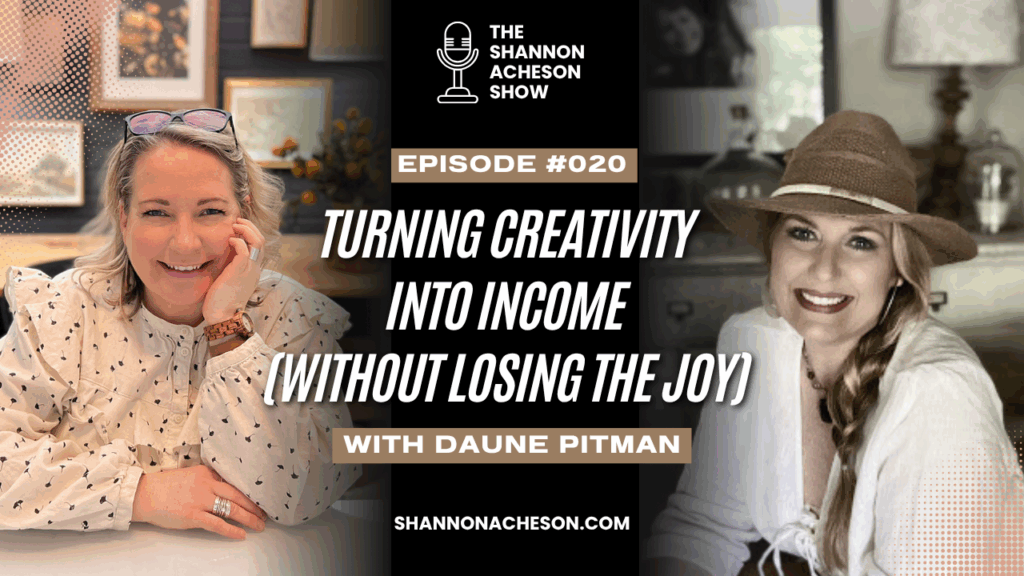
Ep 020: Turning Creativity into Income (Without Losing the Joy) – with Daune Pitman
Watch the Interview
Listen to the Episode Below
In this episode, I sit down with my friend Daune Pitman from The Cottage Table Experience to talk about what it really looks like to grow a creative business with heart.
We chat about following what lights you up, growing through different seasons, and building a business that values connection over scale.
Daune shares how she and her husband built a life and business rooted in art, beauty, and community through creative retreats, workshops, and online courses.
If you’ve ever wanted to build something meaningful that still makes sense for your real life, this conversation will spark ideas and encouragement to do just that.
Key Points from This Episode
- Let your creativity lead the way and let your business evolve naturally through each season.
- You don’t have to have it all figured out before you start. Move forward, even without certainty.
- Diversifying income through in-person and online experiences can create both freedom and fulfillment.
- Connection is more powerful than scale when it comes to meaningful, lasting business growth.
- Refining and simplifying what’s already working can be more impactful than constantly adding new things.
Quotable Moments
“I’ve learned you have to be willing to move forward without certainty.” — Daune Pitman
“We weren’t meant to do every one of our ideas.” — Daune Pitman
“Sometimes smaller brings more connection, and that’s where the real magic happens.” — Daune Pitman
“Your business will evolve just like the seasons of your life do.” — Daune Pitman
“When you do what lights you up, you’ll be willing to figure out the parts you don’t love.” — Daune Pitman
About Daune
Daune Pitman is the founder and creative force behind The Cottage Table Experience — a space where art, design, and community meet. She hosts intimate creative retreats that invite women to slow down, reconnect, and make beautiful things together.
Through her online workshops, live art gatherings, and one-on-one design and creative business consultations, Daune helps others rediscover their creativity and bring beauty into everyday life.
Links Mentioned in This Episode
Cottage in the Oaks (blog)
00:00
Welcome to the Shannon Acheson Show, real business talk for real life. I’m Shannon, creative business coach, digital product lover, and your strategy sidekick. I’ve built a business that fits my life, and now I help other women do the same. No hustle, no fluff, just smart, honest conversations about building a business that works for you. Let’s dive in.
00:30
Hello and welcome back to the show. I am so excited to have my friend Daune Pitman here um from Cottage in the Oaks and a bunch of other things. But I’m so excited to have her here. We met a long, long time ago uh at a conference. um anyways, I’m just so excited to have you here, Daune. Thank you so much for joining me. And yeah, I’m so excited to just chat about all things business and what you’ve been doing. Thank you. um I’m so excited to be here.
00:59
Yeah. So I will start for anybody who doesn’t know you, you can do this better than I can. Can you just give an introduction of yourself and sort of, you know, what you do now? And we’ll sort of go backwards and come forwards again after that, but just an introduction of who you are. Absolutely. I’m Daune Pitman with the Cottage Table Experience. My husband and I were professional ballet dancers before we started our family. And um
01:27
So we’ve always been artists, creatives, and the creative lifestyle, just living creatively in every area of life is super important to us. And so we love to invite other people in and have them be beauty chasers with us and create with us. So we host um creative retreats. We have art and creative workshops here at our cottage in Eastern North Carolina.
01:55
And then I also teach online courses as well. That is so awesome. I love that. so, you know, so all of those things and sorry, cottage in the oaks is stuck in my head, but a cottage table experiences more the business side of things, right? Yes. Yes. Yes. I, anyway, many, many years ago when I started my blog, the name, we named our house oak cottage. Yeah. Um,
02:21
when I started the blog, that’s really what I wanted to call it. And it was taken. And so I took cottage and I was like, cottage in the oaks. And so that kind of ended up being the blog and like my handles and that kind of thing. Yeah, it’s funny how that works. I mean, yeah, I’ve had a couple of different ones over the years too, just because what’s available and where you’re at, right? So, okay, so.
02:49
Cottage in the Oaks started because of Oak Cottage, but how did you first get started? Because we met in Atlanta, I think, at Haven Conference, 12 years ago, quite a while ago, right? It’s been a while. eh But how did you first get started in blogging and sort of creating online? Because I know you were a ballet before and stuff, but then how did you get started with uh blogging and stuff online?
03:17
because I know you do stuff in person now, but initially, start? Well, I think um I started blogging maybe about 15, 12 to 15 years ago. And really the impetus that got me to start blogging was we um had started our family and we used to spend 16 to 18 hours a day creating all day long and performing and
03:47
And so we weren’t spending that many hours a day doing that. So all that creative energy went somewhere. And a lot of it went into just our home, our day-to-day life, just how we did things, how we traveled, how we lived. And we were forever um looking back, we would have done something. And then we would go, oh, I wish we could remember how it was before we did the something. And we didn’t have pictures and we didn’t have
04:16
you know, we only had just kind of sort of what we could remember. So really the blog started as just an online personal journal and we would just document whatever we were doing creatively in any, anything in our life. It might’ve been with our home and it might’ve been with gatherings, anything. And it’s just where it was just became an online journal where we had pictures and we’re just documenting.
04:44
things along the way kind of thing. Yeah. So it really didn’t start as a business initially. was like the traditional like blog. Yes. Okay. And I did not make any money from it, even as a group. Okay, fair. No, mean, that’s, you know what? Everybody takes like such a different route to things, right? Yes.
05:09
uh ours started with a lot of the same before and after, because we were doing a lot of rentals and stuff. But it was, on my part, the Home Made Lovely, the original one, that was a business on purpose, but it was also a journal. So I totally get that. There’s tons of people who started around that same time, because yeah, I’ve been doing this for 15 years too, right? yeah, no, I like that. So you weren’t treating it as a business. Did you?
05:36
ever treat sort of the blog part of things as a business or you rolled into other things, right? Because I know you have like, you you’ve got courses and retreats and like all these things now. So how that sort of come about? Well, eventually down the road, I started because I was blogging, this is hard to believe when I think back on it, five days a week. Yes, I remember. And it was…
06:03
I was always sharing what we were doing and then also how someone else could do it. Like if they wanted to do what we were doing or to be inspired. And then I did get to the point I was like, oh, you know, my goodness, I am, I’m working really hard on this. Even though I’m enjoying it because I love to write, I love to share, I love to bring people along for experiences. And so it did, it did.
06:32
start entering into a business more as a blog, but that was also during the season when blogs exploded and there were just tens of that. There were so, so many of them. it was almost, blogs are still great. I I do still blog, that’s part of my business, but I never went hardcore.
06:57
and I did start thinking about it a little more like a business, but I never fully jumped in. To me, it became a springboard, um really reminding me of all the things that I love to do and that I’m passionate about. And it was all of those things, not so much the blog, but that led into things that are definitely a business. Yeah, yeah. I think…
07:27
that that is something that happened, know, blogs initially did start out as like that journal thing, even those of us who started that journal thing, you know what I mean? Like the online, you know, journal. And even those of us who did go into it, like hardcore as a business, it has changed again now that it’s so, cause when we started, like social media wasn’t such a big thing. There was Facebook, but I think Pinterest was
07:55
either didn’t exist or was a baby like when we started. Instagram definitely wasn’t a thing. So like the blog was where you shared everything, right? That was it. And then we sort of went away from that and shared a lot on social media and then had like the actual projects on the blog, a lot of people. And then it sort of come back around again where like blogs are, it’s so much more about like, I’m gonna say personal brand, but like about who you are and where people, like how people can connect with you too.
08:23
Right. And it’s not necessarily the business part of it anymore. Right. Right. I think, I think a lot has changed in sort of come around to get. Yeah. Yeah. Absolutely. Yeah. So what was so business wise, what was like the first thing that you did? Was it a course like on your own thing? Was it a, was it an in-person thing? Was it a course for someone else? What was the first thing that you did that was like, okay, this is, can make money doing this. Yes. Well.
08:53
It was a little combination. think they kind of all started at the same time. For many years, I had been teaching workshops here in our home. All kinds of creative workshops, whether it was creative home, gathering, art. But I never really put that out online because like you said, there really wasn’t social media. And you know, I was doing and mainly just the people that knew about it were local.
09:21
You know, those were the people that were local and as online presence grew and you started realizing, oh there um it opens a new world, you know as things change and I’m a little bit of a rebel. I Everybody turn in their blog into a business and I will I will never forget uh
09:49
when I do something, I do it 200%. I don’t, I don’t over half way do anything. It means when I do something good, it’s really, really good. That also means when I make a mistake, it’s really big. It depends on how you look at it, but you know, would go to the conferences and I would go to all these classes because I’m like, okay, if I’m gonna do this, I wanna do it the right way. And it was SEO and it was all these things that were not.
10:18
creative, that literally felt like someone was pouring acid on my skin. I didn’t want to think that way. Even though I knew I could acknowledge those things were important, those weren’t the things I wanted to spend my day thinking about. So I think a little bit of that kept me from jumping full in to making the blog a business.
10:44
But what it did push me into is thinking about other things that could be a business. And as things changed, as we gained social media and other avenues, I was like, oh, we could offer these workshops to people that are not just local. Or um these classes that I’m teaching in person, well, gosh, they would be… um
11:12
they would be great as an online class, which is wonderful because that becomes evergreen residual income because once you record that class and edit it and upload it, there’s that main big launch that is all the big hoopla, which is a big portion of the sale of it. But then it stays there forever and ever and for years and years and years it can sell and it’s available.
11:40
I started seeing those kind of things and how wise that was and they were a part of things I love to do. um You know, and when it was something that I really, really loved to do, I’m willing to take a look at those things I don’t like to do. Things that are important, being on SEO is super important. Your website is super important. You know, all of those things. But, um
12:08
you know, that motivation when I was doing something that I could see was successful as well as I loved doing it. It’s like, okay, I’m willing to look at these other things because I love doing this so much. Yeah, no, that’s fair. feel like SEO is one of those things like I
12:27
I resisted for a really long time and then when I started doing it and then everything changed and I was like, well, why did I bother? Like it was like a soul sucking kind of awful thing. That’s what I felt like this is sucking the life out of me. But at the time when we started, there were no SEO people or these people or these people. Like if you wanted it done, you had to learn about it and do it all yourself. Yeah. Yeah. And that’s the wonderful nail.
12:56
I still don’t like SEO. My brain doesn’t think that way. I don’t want to think that way. However, I acknowledge how important it is. now there are people that are amazing at that and that’s their passion and they love it. can’t plug into those people and say, me, you know, and kind of delegate some things that we, we, don’t think we could delegate anything in the beginning. No, no, there was really no.
13:25
I think the longest serving person, like the longest person I’ve worked with is Gretchen Louise, who like looks after some of my tech stuff, like on the background, like stuff I won’t dare touch, like that I never learned, right? Like I go into like PHP and I’m lost and I get like white screen of death. Like, you know, but you had to do it yourself. And so I’d be like, oh my gosh. But yeah, you’re right. I mean, I remember too, like ad stacking myself, like Becky Ferent taught me from Inevitably Creative. don’t know if you remember her, like,
13:55
She taught me how to waterfall ads before the ad networks came out. There was nobody to do that stuff that you didn’t want to do. Oh my goodness. Thank goodness there is now.
14:09
So, did you sort of know when the time was right to shift? So you said you did online courses in addition to like the in-person courses, but now you also have, you know, destination, like, I’m going to say destination or treats. It’s like, I they are the same now. And so how did you know when like, when you were ready to do stuff like that or when people were ready to do that? Were people asking you, was it something you just…
14:37
went, oh, I’m going to try this. Like, how did you get to that place of pivoting from in-person locally and online to the destinations? Right. Well, it seems like the cottage table experience has really evolved um just out of mine and Keith’s life. It was not something that we sat down and we planned out the whole thing, had a business plan, and then said, okay, let’s do it. It has evolved as the seasons of our life have.
15:06
evolved as we’ve just tried to stay in tune, what we love to do, what we’re passionate about, what lights us up. And as far as the retreats, the retreats are part of a vision that we started several years ago. And the beginning of that vision is we love gathering people around the table um for meals, for coffee, for snacks, for creating.
15:31
just spending time at the table is important to us. We both uh grew up in art families, very creative families and big gatherers. And we were that way with our family, but we were noticing our societies, really our cultures getting away from that. so what started is eight years ago, we started a weekly long table meal here at our home. That is not a business. And that is called the cottage table.
16:01
Okay. Because we live in a cottage and um no one pays for that. No one brings anything. They do have to sign up, but every week they come for uh a long table meal and we sit here for a couple of hours. We have a good meal and we, it’s great community and just the stories and the laughter. And that was kind of the beginning of that vision. There are areas in the world that Keith and I have amazing friends and community.
16:31
And those areas are just so amazing at hospitality and spending time at the table. Having that be a priority. So, you know, the long range of that vision is we wanted to bring people back to the table. And yes, what happens in our home every week is the beginning of that and an important part of that, but not a business.
16:56
And, but the extension of that is we wanted to gather people in these places that are like a second home to us and that are so important to us. And that literally in their DNA, um, you know, gathering at the table, whether it’s creating or eating is, it’s, it’s just part of their day. It’s not something that they have to be intentional about and to be able to take people there, not as a tourist, not.
17:23
as a travel trip, not as a tour, but for them to spend a week with us in these places and feel like for that week they live there. truly experiencing, you know, they’re meeting our friends and spending time in their homes and their studios and um doing workshops with them. And we’re taking them around to the places that are special to us, which are usually not the tourist spots.
17:52
So it truly is an experience. That’s also where the name came from. We call our weekly meals, the cottage table. And then for the longest time, for years, as we were talking about this, we knew eventually we wanted to be able to invite people to join us, um you know, in Italy, in France, um in New York City, in Vermont, in different places. And we didn’t have a name for it. And so we referred to it as cottage table on the road.
18:21
That was me and Keith and I. For the longest time, we would call it that. And eventually I was like, we cannot call that. This cannot be the name of this. so, you know, as we were just thinking about, well, what is it? What are we inviting people into? You know, and it truly is, we love to invite people into beautiful experiences. We’ve always felt like, you know, with our children as gifts, we always would rather give them experiences.
18:50
always been big in our family. So experiences are um just such a big deal because I think those are such a big investment in our memory banks. And just, you know, the stories of our lives. So that is the Cottage Table experience. Right. It’s where that came from. And so really a lot of what we do has grown very organically. And then once
19:18
Once we do decide to do something or add something to what we’re doing, we are very intentional about it. But, um you know, I always like to tell people, love ideas and I love to help other people see their ideas come into the room and step into that. I think we have to be willing to move forward without certainty. um we’ve become uh in a place in our culture where it’s like,
19:47
We’re not going to do anything unless we’re sure. Yeah. Or we know all the details or we have the whole plan. Right. And what’s so funny is you realize um I’ve always been an entrepreneur. I started my first business when I was six. Oh my goodness. that spirit of always owned my own business. mean, even as teenager in college and
20:11
And beyond, and one of the biggest things is I’ve learned is we only fool ourselves if we ever get to the point that we think we have it all figured out and we’ve got the whole plan. Because, you know, it’s not ever going to be like all those lovely drawings and lists that we put down on the paper. That can be a great skeleton, but we have to be willing to move forward without certainty. And also be flexible that
20:40
sometimes what we thought this was gonna be for actually takes us in a new direction that’s even better than what we thought. In the first, when we were first thinking about it. Yeah. And I think that really settling in and knowing that comes from some years of experience, right? Of knowing that that’s how it works because it’s happened that way. Right. Right? Yes. Looking backwards, can see how, right?
21:09
Yeah, I think that comes with it with a bit of experience. But if anybody’s listening who doesn’t have that experience, try to try to remember that for sure. Yeah, I know it’s true. And there’s things that we’re doing now that I’m thinking we could have been doing this a long time ago. Hey, but we didn’t. You know, we weren’t at that point. And I also think that, you know, it was it was some of that. Well, we don’t have that all figured out yet. So that
21:38
has to be tabled or it has to go on the back burner, you know. Yeah, yeah, yeah. Yeah, no, that’s, that’s fair because there’s a little bit of, I mean, I think if you, you’ve been an entrepreneur for a long time, I’ve been an entrepreneur for a long time. And I think there is some of that just in us, right? Like that’s just who we were created to be. That’s part of our DNA for lack of a better way to describe it. But I think we do get a little, um,
22:05
I don’t know how to describe it, like a little bit of that, I don’t have, like fearful, I guess. Like I don’t have it figured out, so I better not do that yet. Yeah. Yeah. Yeah. But looking back, it’s like, oh, I could have started sooner. Yeah. For so many things. Yeah. Yeah. And then I think on the flip side of that, and it’s equally as, I guess you could say paralyzing as far as business or growing or stepping into what you’re supposed to do.
22:32
is if you have done something for a long time or been an entrepreneur for a long time, um fooling yourself into thinking that you do already know, you already know this and so that too keeps you from moving forward. It’s true. Because I think, yeah, like being an entrepreneur, it’s always learning new things. It’s always figuring out new things.
23:00
And think that one of the other things I think a lot of people who are the audience for this podcast, I think a lot of it is bloggers who have really struggled in the last couple of years when things have changed so very much. let the best, sort of the quote unquote failure, even though it’s not a failure, sort of get the best of them and not move on, right? And not be like, okay, I can pivot or I can do something else. Like I can add on.
23:30
And just, you know, plugging in, um no matter how independent we are, we’re strong-willed, not that that would be me at all, but… uh As I say this, like those are two things that are often, you know, independent and strong-willed. But no matter um how independent we are or we may think we are, um we need other people, we need community and…
23:59
We can learn so much from other people as well as being a part of a creative network or a small group to where um you have objective voices coming in and cheering you on and encouraging you and seeing things from a different viewpoint when you’re stuck in a spot. Like you said, bloggers that it’s been so frustrating and they feel like where do I go from here or I’m stuck here.
24:28
don’t know how to grow out of this kind of thing. Yeah, and I think it’s really easy to get sort of, I don’t know, like a hermit, like sort of turn into yourself, especially if things aren’t going well, right? Because you’re like, well, I don’t have anything positive to share. Things are just whatever. you know, I mean, for me, it’s a really, I’m an introvert. So like, I’m okay this way.
24:54
But in a room full of people, it’s hard. And I think I just end up feeling like I am doing things by myself, right? Especially the last few years, right? Because things were weird and whatever. And then I wrote a couple of books in that time. So that’s kind of a solo job. Yes. Right. Yeah. So community, I love that reminder that community is so important and to make sure that you stay in community with people. whatever.
25:23
any of us are struggling with at any given time, I think it’s so easy, and I think this is universal, to feel like you’re the only one. Because you look out there and because we are in an online world, and a lot of what we do in these businesses are online, well, naturally, we’re not putting online our horrible days or what we’re struggling with or what we’re frustrated with because
25:52
that’s not what you do. And that’s also not what people want to see. It’s kind of like, you know, people would always say when, when I was doing a blog, would hear people say, oh, well, you know, all bloggers just make their houses like magazines or whatever. And I’m like, well, do you really want to pick up a magazine and see dust bunnies and dirty underwear? is that what you’re paying for? But you know, when everything these days is put online,
26:22
It is everyone sharing their best. Not that they’re not being authentic, but naturally you don’t put um those things that you’re really, really struggling with. And so it makes it really easy to look like everybody’s doing great or nobody else is having this problem except for me. So what is wrong? What have I missed? What is fault? It’s a thing. Yeah, no, it’s such a tricky thing because like,
26:51
sharing some of that stuff online isn’t necessarily the best option. Not just that people don’t necessarily want to see it, but it’s not necessarily a safe space for sharing stuff. But then when that’s what you’re looking at all the time is everybody else’s perfection or not perfection, but even just their best days or the highlight real as they call it. It is hard to remember that. So I think it’s such a good reminder to be real with people in real life.
27:20
to like spend time with people. You have that community. can’t, you know, you know, this is going haywire or this isn’t, you know, what am I missing? To have that group that is safe. And it doesn’t need to be a big group, you know, just two or three people that you know they will understand, but you can share with, you can bounce ideas off of, they’ll hold you accountable.
27:45
That’s always good. Yes, it is. No, that’s just so true. So looking at all the different things you’ve done, and you do not have to be specific as how much money you’re making or anything like that. don’t mean that. What sort of, as far as business perspective goes, because I know you love, you’re creative, so you love the things that you do, but what has been sort of the most
28:12
the best return on your investment as far as like what you’ve created from a business perspective? I would have to say online courses and the in-person workshops. Okay. Yeah. Yeah. But I would probably have to say overall, if I had to pick one aspect, it would be the online courses. Yeah. And is that, that’s because of the sort of record it, like create it, record it once and then it’s available? Yes.
28:42
Yes. It’s such a smart business model. makes sense. That totally makes sense. So what part of your business lights you up the most right now? What are you most excited about of the things that you’re doing in your business? Definitely the in-person things. The uh workshops that we do here in our home, we love to gather people. uh
29:11
um just the retreats. They are so very special. Most people, when they’re leaving, they’re like, this has literally been life changing, which is very validating for us because that’s really what we want to invite people into. So those are the two things that I love the most because they are in person. I’m such an in-person person. That’s great. No, that’s good.
29:40
And I’m an extrovert, but I’m an extrovert that also I have to have my by myself time. But I just, both Keith and I love to gather people and be with people and um invite them into beauty and encourage them and share the things that we love. those would be the two biggest
30:05
I’m getting all these flashes of like all the pictures I’ve seen of like the table and stuff like over the years, like when you’ve shared it, I’m like, you’ve done stuff. You did. I’m like, there’s one out. You did some outside too. Did you not? feel like you do a lot outside and inside. Yeah. Yeah. Yeah. And then the long table inside. Yeah. We actually rearranged our home and, um, our, well, the part of our home that was actually built to be the dining room is our.
30:35
den living room and the part of our house that was meant to be the living room is our dining room so we could have a longer table. Yeah. It’s been that way for a while, no? It has. think about 10 years. Yeah. Yeah, I thought so. We had done that at our last house too because the dining area was quite small and then the living area was much longer so we could put a longer table in there. Yeah. oh
31:01
Yeah, we do what works, right? Absolutely. Yes. oh Also, I don’t know, as we’re talking about this, can see how that can so be a good example for business. So we go into these homes that we buy or that we build or whatever, and it’s like, this room is this, this room is this, this room is this. And we just think of it that way. And we even put our rooms in a box. Yes. Forgetting that that
31:27
that home is ours. We can switch those rooms. They can be whatever we want to be. Like, if have a room that was a bedroom, it’s now a library. we’ve switched the dining room and the living room. And to remind ourselves, we can do the same thing with our business. it’s like we’re at a point. It’s like, oh, I’ve always thought I have to do it this way or do this. You know, what is something that could come out of that box?
31:57
Yeah. You get in a different direction. Which is, yeah, that’s such a good, it’s such a good visual, but such a good lesson. Because I think some people, several people I know have switched rooms or whatever, but such a good lesson. Yeah, because we get stuck in these ruts of what we think. Like, think one of those things is bloggers, we think that that’s all it is, right? We we are a blogger. And we, you know, this is how we make money. This is how we run things, we make it from ads. And that’s all there is when
32:25
There are so many different ways or just SEO is the only way to get people looking at your stuff. And it’s like, oh my gosh, there are so many other options and so many other things. Yeah. So what do you think your audience responds to most? Do you think it’s the connection, teaching that you do, transformation or something else or all of the above combination?
32:53
Well, I think it is a combination, but I would say connection. Yeah. Yeah. Would be number one. Yeah. Yeah, yeah. No, that absolutely makes sense. OK. So we sort of touched on this about that there are other options and other ideas. But if another creative business owner is listening to this and they’re sort of wondering how to add new income streams like you have, like lots of other people have,
33:20
What advice would you give them about where to start with adding different income streams? I think the best place to start is to really take a big look at yourself and like what you just asked me, what lights you up? What do you get excited about? What do you know and what are you good at that
33:49
there are other people out there that would love to learn or to be invited into that. And to start there and just to get out of that box because you know it’s interesting, most of the people I know now that I’ve been a part of creative masterminds with and that kind of thing, we kind of all started a long time ago with a blog and we still have that blog.
34:16
But there are no ads, there are no, we’re not a blogger anymore, even though we have a blog and we will blog. mean, let’s not over it. But really, we have, our businesses have grown in new and different directions and we really just use the blog to support that new business. Right, sort of for marketing or for connecting. Yes, marketing as well. And it’s a great way for your
34:45
audience to get to know you personally. That you get to share behind the scenes stuff and you know your day to day life or those kind of things which really um that’s really what people are connecting to. They want to know really that big corporation model that has been around for so long. Not that it’s not still out there but you’ll even notice the huge corporations are actually trying to be smaller. Yeah.
35:14
you’re trying to appear smaller. They want to connect relationally with their audience and everyone out there. And I think a lot of times those of us that are smaller, we’re not giant corporations. We can get it in our head that we’re supposed to be trying to be a big corporation. That’s what’s gonna work, but that’s really not what people want. And so a blog, um
35:41
even as you branch out and do other things is a big part of that connection and being able to share things in different ways, as well as to promote your heart behind and whatever else, whatever you’re doing in those other actions. Right. I think, yeah, that’s something that I’ve realized in the last little while is personal, like,
36:07
what you would call personal brand, right? Like people will connect so much more with that. And I think that’s why like big companies will do like a spokesperson or whatever, right? Cause there’s some person to connect with. And so, so I think that’s really come back around to that a lot. I think we sort of lost it a little bit. A lot of us for a while trying to be the bigger, you know, step back and be the bigger company kind of thing or the media company or whatever. Yeah. Yeah. The connection for sure.
36:38
So then how do you decide, so you said you’re like 200 % into things when you start something. So how do you decide then, and as a creative person, because I know personally, I have like a million and one ideas and I can’t possibly tackle them all in my lifetime, nevermind at the same time. So how do you personally decide what’s worth pursuing and what’s sort of just gonna be a distraction and not sort of lead you where you wanna go?
37:07
That is such a good question. A good thing to think about because, um, you know, Keith tells everybody, he told our kids as they got older and they could drive there, he said, if you get your mom a tea after 4pm, you will be grounded. is, caffeine greatly affects me. Yeah, me too. After a certain time of day, if I have caffeine, I mean, I am up all night. I could rule the world. I mean, I’m not bouncing off the walls, but I’m like,
37:37
I already am thinking and have a lot of ideas all the time. And then I have caffeine and yet two in the morning, I’m jiggling Keith saying, Hey, are you asleep? have an idea. literally drink coffee three days a week and that’s it. I can’t handle the caffeine. But I think that is, is any creative. There is no lack of ideas. um
38:07
And I think our ideas alone can be a distraction because we have so many and we can even have so many good ones, but we weren’t meant to do every one of our ideas. And I know for me personally, I’m old school and analog. um I like real books. I like pen and paper, even though I’ll use the bells and whistles that we have available, but I still pen and paper. um
38:36
writing things down as well as talking them out. Which where that small community comes from, know, Keith and I will talk things out. But sometimes as I talk things out, hearing them out loud, I don’t even need a response from anybody. can say, no, that would be stupid. What in the world? In my head, that was great. But now that I hear myself saying it, what? That, no.
39:04
And then sometimes as I talk things out, they actually evolve and I get more excited about them. And just to weed those things out, um that even though they might be a great idea, they aren’t for you, or at least not for now or whatever it is. And to just be able to get it out. I think as creators, it’s really easy for us to stay in our head.
39:31
And that’s where we start spinning in those creative circles that it’s all ideas, but never do. know, we’re, have idea, idea, oh my goodness, oh my goodness. And then you realize how many, I haven’t done anything. Like I haven’t stepped forward into anything. So I really think our own ideas can be a huge distraction if we, if we let them. Right. So then talking them out.
39:57
Talking about loud with other people is what sort of helps you decide what. Yeah, writing them down and down, right? And then and talking them out with, I know that’s what helps me. Yeah. You we out that, you know, the things that no, that’s not good or hey, this, this, this, I think would be a really neat thing. Yeah. Yeah. Yeah, that’s.
40:20
That makes sense. do, we around here when the weather’s nice, we have uh porch coffee and many decisions have been made having porch coffee while we have our coffee and just chat out ideas. Yes. Right? Like so talking about things for sure, writing things down for sure. And then, and then so how do you with all those ideas then, this was the question that came to my brain, um how do you with all the ideas and I know you talk them out, but then how do you make sure that you’re not just
40:48
what you said, because the ideas are exciting, right? Like the thinking of ideas and just the possibilities with them are so exciting. How do you then make yourself like step out and take the action and do the action? Like is there sort of a process or a, don’t know. How do you then just actually do the work? Well, I think um for me, once I get to the point like, oh, this is a really good idea. I want to do this. And then,
41:18
not thinking about the other ideas, like intentionally. And then it really is just choosing to be intentional. And focusing on whatever that is and then breaking it down, reverse engineering things. think reverse engineering anything, especially in the creative world, if we’re gonna, as a business, is so valuable because we always think of the idea and try to work up to what it’ll actually be.
41:48
Whereas I think it’s great to cast vision and to have that big vision, like whatever that big vision is, and then reverse engineer it backward to say, okay, well, where do we start to be able to start working toward that? Because nothing happens overnight or even over week or month. Sometimes, yeah, it’s true. And then I think…
42:11
You know, putting yourself, and this just really takes intentionality. It doesn’t happen by magic. Like you just have to decide to do it. um You know, once you have that great new idea and you’re like, really want to do this, and start that reverse engineering and figuring things out to put yourself on, things have to go on the calendar. And then you’ve gotta start giving, okay, by this date, I need this accomplished, or.
42:41
by this date I need to have contacted or moved forward or whatever it is that might be happening to contact these people or do this, I need to be at this point and holding yourself accountable. And then if you do have that good creative mastermind group type of thing, saying it out loud to them and because then you’ve got other people that, know, when you meet next month,
43:08
hey, you accomplished this, this, this? How’s that going? Or whatever. And then you’re just like, oh, you know. Well, yeah. It’s so true. Having that outside source, being able to follow up and check on you. And along the way, there are going to be hurdles, whatever it is, no matter what we do, no matter how long we do it, there’s hurdles, things change.
43:38
things get frustrating, there’s discouragement, and it’s good to have someone, whether that’s your spouse, your best friend, your creative community saying, okay, so this is where you are right now, but you’ve been here before, this has happened before, so you just gotta get past this, just to be able to affirm and call out those things that you’re good at, and that you just have to get over this hurdle.
44:08
Yeah, we do get so much in our own head. Sometimes I feel like in a good way for all the ideas and creativity, but then in a not so good way sometimes when we’re our own worst enemy. Yes. So what is next for you and Cottage in the Oaks, Cottage Table experience, all of that? Is there new stuff coming that you can share? there, you’ve got a next retreat coming, I guess, or experience coming?
44:38
Well, we just started releasing our retreats for next year and soon we’ll release our spring workshops that we’re gonna be having here at our cottage. And right now there isn’t uh like uh a new avenue, like something brand new that we’re doing outside of the online courses, the workshops and retreats that we’re already doing. But… um
45:05
I feel like what we’ve really been working on this year is to hone those things that we are already doing. Okay. You know, we’ve had a wonderful response and which is always great, but sometimes um when some things go gangbusters, that looks great and it is, but like we realized we have had um
45:33
We’ve now done 15 creative retreats. And we have a couple more this year. And then we’re working on next years. But what was really on our heart and what we saw this year is we want to make them smaller. Which you would think, usually in business, is always about bigger. But bigger is not always um more valuable or even profitable.
46:02
And we just realized for what we love and I think what people really get the most out of our offerings, which is connection and special experiences, we see the difference between a group of 20 and 25 and a group of 12. We see that difference that even though we’re doing all the exact same things,
46:33
incredible the difference in the connection. So going forward, we’ve decided um to make our retreat smaller and we’re excited about that. So really it’s for us right now, it’s not about we’re adding this whole new thing to our thing. It’s really about honing and polishing what we already do uh because we launched a lot of this stuff during COVID. m
47:03
and I think everybody was just holding on for dear life. uh And we were just constantly, because of the climate we were in, the business climate, we were just constantly grabbing for straws. Okay, we’ll do this. Oh, pivot, we’ll go over here. And then all of a sudden, you kind of realize maybe some aspects of your business just out of survival is a little bit like a mutt.
47:32
hate to say that because that sounds negative. But you you’ve kind of just got a little bit of everything because you were just figuring out everything was just so crazy and changed every other day. And sometimes it’s good um after periods of big growth or something like we went through COVID.
47:55
is to stop and instead of thinking about what are some other things we can do is, okay, let’s look at what we already do and is there a way we can make those better? Right. More quality, know, even higher quality or, you know, polish those. And that’s just where we are right now. Yeah. I think, yeah, after the throwing spaghetti at the wall kind of thing, right? To see what sticks and what. No, that’s fair.
48:23
That’s a great place to be into, to be able to look at it and go, okay, what is working well? What can we be it, make it smaller like the retreats? And I can totally see how that would be better to have half the amount of people to connect with then, right? Like, I love that that’s what you guys are doing right now is looking at that and really focusing on and refining what you already have and what you already do. That’s so good. Okay, oh so.
48:52
Where is the best place then for someone to find you online and what you do? Where’s the best place for them to go? Our website, which is the cottage table experience.com. We believe in short website names. And then on Instagram, am cottage in the yolks. Okay.
49:20
Awesome. Both of those places are great places to connect. Okay. Awesome. I will make sure that goes in the show notes so people can connect with you after this if they have any curiosity or interest in what it is you’re doing or any of your experiences or any of that. Thank you so much for coming on the show today and talking about this. It’s been an honor to be here. Thank you. Thank you so much. oh
49:49
And that’s it for today on the Shannon Acheson Show. If you found this helpful, follow the show and share it with a friend. And hey, if you’re not sure what kind of business actually fits your life, take the free quiz at shannonacheson.com. It’ll point you in the right direction. Thanks for listening. Talk again soon.