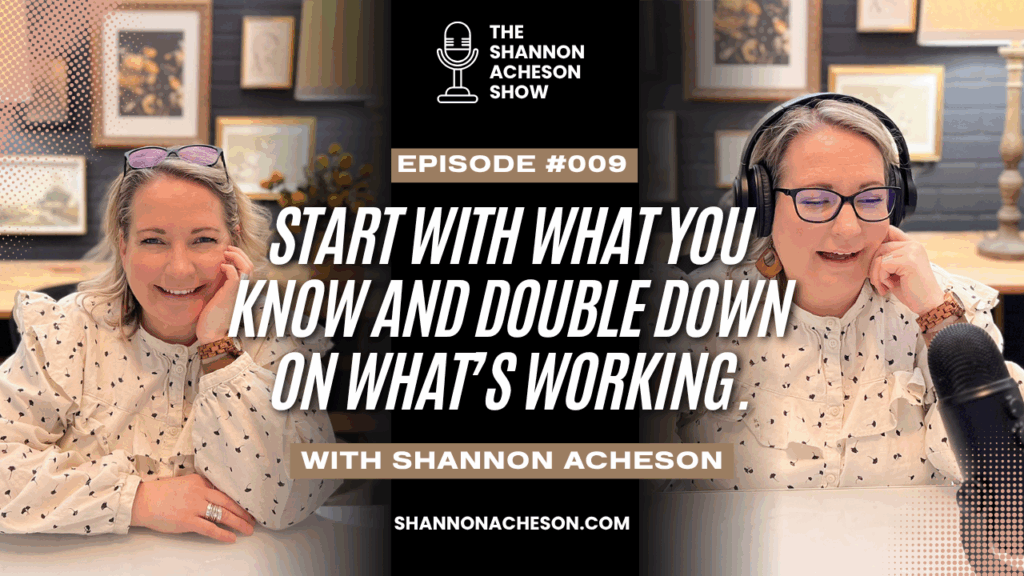
Ep 009: Start with What You Know and Double Down on What’s Working
Watch the Interview
Listen to the Episode Below
I used to think I had to know everything before I could really grow my business.
Spoiler: that kept me stuck.
The truth? You probably already know enough to start — and the fastest way to make progress is to lean hard into what’s already working. In this post, I’m breaking down five simple, no-fluff lessons you can use to cut the noise, focus your energy, and start treating your online business like it’s the real deal.
Key Points from This Episode
Start with what you know.
You don’t need to be the top expert — you just need to be a few steps ahead. Your lived experience is enough to teach, share, and help someone else move forward.
Focus on what’s working.
If one topic, product, or platform is bringing results, give it more of your time and energy. Drop what’s not moving the needle.
Share your real story.
People connect with people, not faceless brands. Your personal experience builds trust and keeps your audience coming back.
Show up consistently.
Plan ahead for busy seasons so you can still publish, post, or serve without disappearing. Consistency builds momentum.
Treat it like a business.
An online business is still a business. Know your people, show up where they are, and give them a reason to buy from you.
Quotable Moments
“You are most powerfully positioned to serve the person you once were.”
— Shannon Acheson (quoting Rory Vaden), 02:08
“If your time and bandwidth are limited, you have to focus on the things that give you the most return on investment.”
— Shannon Acheson, 06:45
“People want your real experience — that’s why they follow you.”
— Shannon Acheson, 17:12
“Be consistent with your content. Work ahead if you’re going to be off so people still know what to expect.”
— Shannon Acheson, 25:44
“An online business is just a regular business. You need to find your people and be the expert they’re looking for.”
— Shannon Acheson, 33:12
Links Mentioned in This Episode
00:04
Welcome to The Shannon Atchison Show, real business talk for real life. I’m Shannon, creative business coach, digital product lover, and your strategy sidekick. I’ve built a business that fits my life, and now I help other women do the same. No hustle, no fluff, just smart, honest conversations about building a business that works for you. Let’s dive in. Okay, here’s the deal.
00:31
After every guest episode, I like to pause for a sec to pull out the good stuff. The moments that made me nod, scribble notes, or rethink something I thought I believed. There’s always something they say that sticks with me. A tip, a mindset shift, a smarter way to do something. And I don’t want these conversations to just sound good. I want them to help you build a business that actually fits your life.
00:58
And I figure if I needed to hear it, maybe you did too. So this episode, it’s just that, the gold, the stuff you can actually use. Short, punchy, and straight to the point, so you can take what you need and run with it.
01:15
Okay, welcome back to the recap episode. Today, I am sort of going over the five key tips or insights that I pulled out of my interview, my last interview with Lisa Bass from Farmhouse on Boone and Simple Farmhouse Life. So Lisa has a blog, Lisa has a YouTube channel and a podcast. She has courses, among other things. And I just, admire Lisa so much. We’ve been in business.
01:44
about the same length of time. think she started a little bit after me with her blog, but you know, I really admire Lisa and what she has done with her business and the choices that she has made. And so to sort of amplify that, I wanted to pull out five key things. Well, it’s not that I wanted to pull those things out. It’s just when I took notes, when I went back and listened and edited that episode, there were five things that really stood out to me from that episode. And I wanted to share them with you because they’re sort of these
02:14
maybe not universal, but super close to it, universal sort of business truths that just in our conversation that I feel like really, really, really stood out, like I said. So the first thing is to start with your experience, like your knowledge, your experience, where you’re at. I know that Rory Vaden from Brand Builders Group says, you are most powerfully positioned to serve the person you once were.
02:40
And sort of that’s what I’m getting at right here. It’s what do you know well in what topics and, know, areas of expertise and niches are you ahead of other people by even just a little bit, like 10 % further down the road than someone else. Lisa started Farmhouse on Boone with the thought that she had something to offer, which was 10 plus years as a mother and homemaker. She had that experience. She had that knowledge of running her household.
03:09
I think when she started, she had four or five kids already at least. And so she had that experience and that’s what she started with. Excuse me. After that, the second thing I wanted to share is to make business decisions based on what works. So Lisa sort of started out, she knew she wanted to talk about being a mom and homemaking and all the things involved in that. And over time, she sort of just niched down.
03:35
further and further because she discovered that certain topics were doing far better than others when it came to audience reception and ad revenue and all of those things. And so you have to focus on the things that have the best ROI. If you are out there sharing about 10 different things, first of all, I don’t recommend that, but if you’re out there sharing about 10 different things, let’s look at my homemade lovely website, for example.
04:00
I started out with DIY and decorating and over time I sort of branched out to include lots of other things like recipes and decorating and organizing and decluttering and all of those things. And while they all relate to home, some of those took off better than others. And so when you’re running a business and your business is not just a hobby, not that there’s anything wrong with having a hobby.
04:24
But if you wanna run a business, you need to focus on the things and pivot and niche down to the things that have the best ROI. Especially if you’re in a season where your time and or your bandwidth, your brain power is limited. If you have little kids at home, if you are moving, if you are suddenly an empty nest or but don’t quite know what to do with that, any emotional, anything. When your time and your bandwidth are limited, you have to focus on the things
04:53
that give you the most return on investment, ROI. That’s what that means. In case anybody didn’t know that, I’m pretty sure you did. Okay, so the third thing that I talked about with Lisa Best was blogs are back to being more like personal brands again. So I blogged on Homemade Lovely, I have blogged on Homemade Lovely for 15 years. That means I started in the summer of 2010. And back then, like,
05:19
almost no social media existed. know, Facebook was around. I don’t think Instagram was released until the next year. I could be very wrong on the exact dates. The point was is they weren’t mainstream. There wasn’t a lot of Instagram. There was Facebook, but it was different. Pinterest wasn’t really a thing. And so, you know, now if you want to share with your family and friends or even your audience from a business perspective, you hop onto Instagram stories.
05:45
Well, at least I do. Or if your audience is on TikTok, you hop on there and you share about what’s happening in your day or behind the scenes or whatever it is. But back when we started our blogs, that was where we did it. I would share stuff like, you know, I took the kids, I was homeschooling, like my kids are grown now, but I was homeschooling. So it was like, okay, we did this. We went to Home Depot for the project supplies, but we also grabbed a bite to eat. And, you know, we went to the zoo or whatever it was. And so…
06:13
Over time, obviously we went away from that and the advice that we were given over and over again was to make it not necessarily less personal, but less like that. Make it more like you’re teaching. Write for SEO. Look for those keywords that Google will send you lots and lots of traffic juice and your ad revenue will go up. You know, when I started ads were barely a thing too. I feel like I’m so old.
06:41
Ads were barely a thing too. mean, I remember someone taught me how to waterfall stack Google ads on my website so that like the highest paying ones would come in first and when they ran out, it would go to the next one. Like the manual ad stacking was insane back then. And so, you know, over time everything shifted and we, I mean, I went along with it. I took the advice of those people and I started to post more for SEO and a little less for
07:09
you know, what I personally thought that my audience should have, should be taught or shared or whatever. Now it’s swinging back that way over the last couple of years a lot, especially with the development and introduction of AI. AI can spit out those summaries that say, for example, where I used to teach, here’s how to decorate a room in five steps. AI can summarize that for you in the top of Google. Now that’s not in depth. That’s not anything, you know, well, in depth.
07:39
But now people want your personal experiences. There is a reason that Reddit is a big deal. It’s because people share their unfiltered, truly what their experiences are. So your audience wants that real experience. You know, I keep coming back to you now what my most popular posts are, and they’re things like, you know, my IKEA Ektorp sofa review post. I mean, we’ve had that sofa for like, oh my goodness, like eight years.
08:08
We love that thing. And I have updated that post with sort of our every couple of years with what our experience of it is. And that is one of our absolute most popular posts because people want to know how that sofa functions in real life, how the slipcovers work, all of that. Even though IKEA has since discontinued that, there are so many out there still kicking around and there are so many secondary, know, slipcover sellers and all of that.
08:36
And so people want your real experience with things. So even if, like me, you are a teacher, people want to know what your thoughts are on something. And here’s the thing, that’s why I do these recap episodes, besides that I get to just share all kinds of things that make me excited that I’ve learned. It’s because the interviews are awesome. I’m asking questions. The guests are amazing. I love the guests that I’ve had on so far and that I’ve got scheduled to come.
09:06
The recap episodes that I do between are so that I can pull out and share what my impressions of those conversations were and my impressions of what I feel like are some really awesome takeaways. so blogs are more like personal brands again. That doesn’t mean you have to share your everyday life to the like nth degree, but people want to feel like they know you.
09:30
The fourth thing that I really want to share is that Lisa really hammered home and I know this is true in my experience as well when I’ve been good at it is being consistent with your content. Whether that is, know, whatever your marketing content is, whether that’s your blog posts, your YouTube videos, your Instagram reels, stories, carousels, whatever your Facebook shares, wherever you are sharing your content.
09:56
Be consistent with it. Email counts in this category too. If someone signs up for your email list and you email them that here’s your freebie kind of thing when they sign up and then you don’t email them again for three weeks, they’re gonna be like, why did I sign up for this again? Who is this person? And then say you wait another like two months and you try and email again, they’re gonna be like, what the heck? Like people like to know what to expect. And you have to treat your content a bit like, I’ve heard this explanation before, I forget where.
10:25
where you treat it like a sort of news broadcast. The news comes on, at least it used to, we get it everywhere now, but the news comes on every night at like, say six o’clock. And we all know to expect that. Your people who love what you share and you teach, they’re gonna wanna know when to expect your content, when to expect your emails. This is every Saturday morning at seven o’clock where they sit down with their coffee.
10:50
and read your email. Is it every Monday morning where you share like the best tips about, know, what’s coming up this week, any, whatever that is, work ahead so you can keep up your consistent schedule. Schedule your blog posts, schedule your social media stuff, schedule your emails. You don’t have to work really far ahead, work a week ahead, work a month ahead, whatever works for you in order to help you keep your consistency.
11:17
doesn’t mean daily, but whatever your consistency is, and your audience will come to expect that. And that will return to you in the form of traffic and comments and likes and purchases and all those things. You can even do that. This came up because Lisa was talking about when she has babies. I think she’s about to have baby number 10, I think we said. I think she said on the episode. that’s 10 times where she could have let her content sort of fall off the map.
11:47
Instead, she still took a bit of a break because she has some really great, you know, staff members or contractors, whatever, but she also worked ahead so that her content was still coming out. Her audience still knew what was coming. Okay, so that’s the fourth thing is be consistent with your content. And then the fifth and last thing is, you know, Lisa said this and I was kind of like, yeah, okay. It’s online business is just a regular business.
12:14
I think sometimes we think that we are super unique in this online world or vastly different from businesses that aren’t mostly online. And the thing is, is yes, that’s true. Let’s say a retail store or a brick and mortar, that’s gonna be very different. There’s different overhead, different expectations, all of that, than a completely online or a mostly online business that…
12:42
Is there for content? there that sells digital products or services or anything like that? They’re both businesses and you need to find the people to buy what you’re selling or vice versa. You need to find your people who are interested in your experience or your niche and you need to find out what it is that they need. What problem do they need solved? What solution can you give them? And then
13:11
Go and be in all the places where those people are, where they’re looking for that sort of advice. Facebook groups, forums, other people’s podcasts, guest on other people’s podcasts. Guest posting is kind of, eh, sometimes, because we all get those crazy pitches. But be in the places where your ideal avatar, your target audience, your person is, and then be the expert in that area. Don’t.
13:39
you know, sell, sell, sell, sell, sell, but answer their questions. Be seen as the expert by doing that. There are so many ways to build an online business and to draw in an audience. Of course, there’s ads, but if you are in a place where you don’t wanna do advertising or you still have that little, you know, brain hiccup when you think, oh my gosh, like, for example, I used to write a blog for so long and I never had to run ads. I never had to pay to have people see my stuff.
14:06
know, things change over time and might I recommend that ads aren’t a terrible thing if you have the budget for them. But there are also so very many ways to get other people’s eyeballs onto your work, your products, your services. And so, you know, if any of that, I actually have a list on a blog post on shannonatchison.com with six ways right there in the blog post. And then there’s an opt-in for 35 more ways.
14:35
to get people’s eyes on your content. So, you know, make sure you check that out for your online business. Anyways, that is sort of the five things that I really took out of my interview with Lisa Bass is start with your experience. Where are you already ahead, at least a little bit of other people? Make business decisions based on the ROI. What is giving you the best return on your investment, your time, your money, your energy, especially in a tough season?
15:04
If you are a blogger and you’re listening to this, blogs are back to being sort of more like personal brands. They’re different than they were originally, yes, don’t get me wrong. However, people want your experience. They want your point of view. That’s why they follow you. That’s why they choose you and your email list to subscribe to. Be consistent with your content. That’s the fourth thing. I mean,
15:28
Just be consistent. I don’t know how else to say it. Work ahead if you’re going to be off. know, make sure that you’re consistent so people know what to expect. An online business is just a regular business. Treat it, you know, as an online business, but also look at where your people are and that will help you so much in the long run. I hope this debrief was super helpful and I look forward to talking to you on the next one. Okay, that’s it for today. Just a few takeaways to tuck in your back pocket or to try out this week.
15:57
If one of them hit home, I’d love to hear. Email, DM me, or leave a review. And if you haven’t listened to the full interview yet, go back and hit play. It’s totally worth a listen. That’s it for today on The Shannon Atchison Show. If you found this helpful, follow the show and share it with a friend. And hey, if you’re not sure what kind of business actually fits your life,
16:25
Take the free quiz at shannonatchison.com. It’ll point you in the right direction. Thanks for listening. Talk again soon.