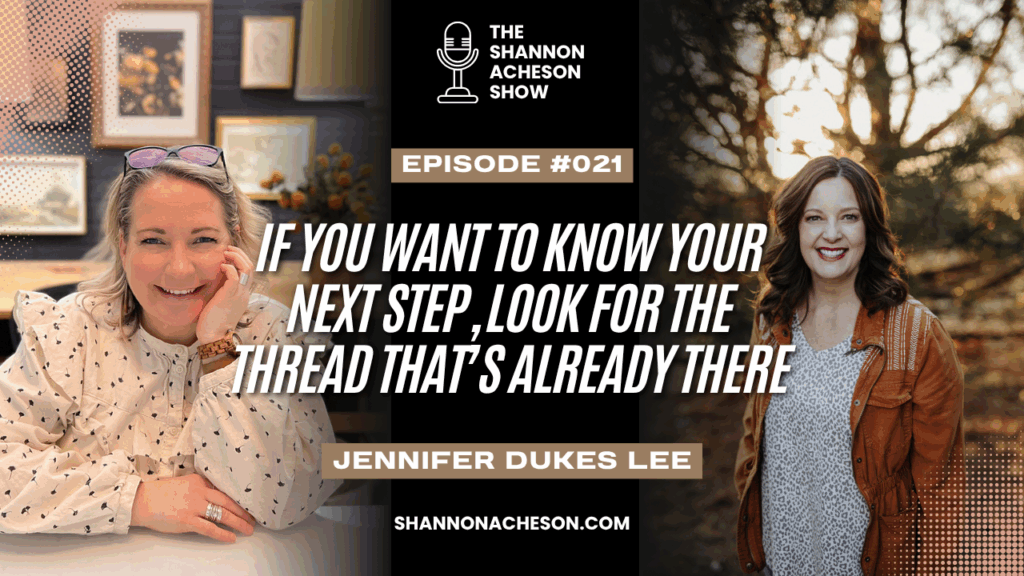
Ep 021: If You Want to Know Your Next Step, Look for the Thread That’s Already There – with Jennifer Dukes Lee
Watch the Interview
Listen to the Episode Below
I hit record with Jennifer and instantly felt that familiar little spark in my chest. The one that whispers, “There’s something here. Pay attention.”
Jennifer has lived a few lifetimes inside one career. Journalism. Blogging. Books. Editing. Speaking. And the wild part is that none of her pivots ever came from panic or confusion. They came from paying attention to the thread running through her whole life.
Words. Story. Serving people through the things she’s actually walked through.
And honestly, the way she talks about following open doors made me want to grab a notebook and rethink everything I thought I had to “figure out” first.
This episode… it’s a gentle nudge to look at what’s already there instead of forcing yourself into something that doesn’t fit.
Key Points from This Episode
- Why your calling often stays the same even when your job titles change
- How Jennifer went from newsroom journalism to blogging to books to acquisitions editing
- The “thread” that guided all of her pivots
- Why paying attention to what people ask of you matters
- How serving from lived experience changes everything
- What makes a book idea stand out to publishers
- Why your platform doesn’t have to be huge if the idea is strong
- How to embrace change without feeling like you’re starting over
- The difference between promoting a message versus promoting yourself
- Why Jennifer still loves talking about her books years after launch
- Her rhythms for writing, editing, and keeping her work grounded in real life
Quotable Moments
“I’ve learned that when someone speaks confidence into your life, you should pay attention.” — Jennifer Dukes Lee
“Your calling doesn’t always change. Sometimes it just finds a new outlet.” — Jennifer Dukes Lee
“You don’t have to wait for a publisher to validate your message. Start serving people now.” — Jennifer Dukes Lee
“The work never ends, but the day has to end. I turn off the light and say goodnight to my office.” — Jennifer Dukes Lee
“The thing you loved as a kid is often the thread running through your whole life.” — Jennifer Dukes Lee
About Jennifer
Jennifer Dukes Lee is the bestselling author of several books, including Growing Slow, It’s All Under Control, and Stuff I’d Only Tell God and Acquisitions Editor at Bethany House. She’s a fan of queso, bright lipstick, and singing too loudly to songs with great harmony. She lives on a fifth-generation family farm in Iowa, where she and her husband have made a life of growing crops, pigs, two beautiful humans, and an enduring faith.
Links Mentioned in This Episode
• Jennifer’s website: https://jenniferdukeslee.com
• Jennifer on Instagram: https://instagram.com/jenniferdukeslee
• Jennifer’s books: search “Jennifer Dukes Lee” wherever you buy books
• Growing Slow (affiliate link)
• How to Love Your Morning (coming April 2026)
• My free quiz: https://shannonacheson.com
00:00
Welcome to The Shannon Acheson Show, real business talk for real life. I’m Shannon, creative business coach, digital product lover, and your strategy sidekick. I’ve built a business that fits my life, and now I help other women do the same. No hustle, no fluff, just smart, honest conversations about building a business that works for you. Let’s dive in.
00:30
Welcome back to the show. I am so excited today to have Jennifer Dukes Lee with us. And I have known her. was my acquisitions editor at Bethany House for both of my traditionally published books. And so we’ve been sort of connected for, oh my gosh, four, five, six years probably now. I think so. You were one of my very first authors. Yeah, I was. That’s right. Maybe even the first. I think maybe it was. Yeah, think it was just that summer. Yeah.
00:58
Yeah, yeah. Oh my gosh, that’s awesome. So Jennifer, thank you for coming on the show. Welcome. I’m so excited to have you here. And I would love if you would just sort of introduce yourself, how you would introduce yourself to anybody these days. Oh, wonderful. Well, I am Jennifer Dukes Lee and I live on a fifth generation family farm in Northwest Iowa. We are growing crops and soybeans. We also grew two beautiful children who are
01:27
doing other things now. in addition to that, I am so yeah, I’m a farmwife, but I’m also an editor. I’m an author, a speaker.
01:37
And love and life in Iowa in this. man, Shannon, if you were to come here, a rush hour traffic here is the neighbors cattle got out and are blocking the road. And we literally live in a county where pigs outnumber people by a huge margin. So there we go. No stoplights in the little town where we live. I didn’t realize it was fifth generation. knew it was family farm, but I didn’t realize it was fifth generation already. Wow.
02:07
Wow, uh that’s wild. Okay, so we’re going to talk about sort of like all your pivots and all the things because you’ve done lots of things. actually peaked because I always do. I peaked at your about page just before we came on just to refresh my brain a little bit on your website. um But like you’ve like you’ve done lots of things. There was like mention of you were a mime at one point.
02:33
In there, you’ve been a journalist. You’ve, you know, like you said, you’re an editor, you are speaker, all of those things. Looking back, is there sort of, is there a common thread through any of that, like through all of that that you can see and sort of pull out at all? oh Aside from the miming where no words are allowed, the common thread is words.
03:00
And so to clarify to the listeners that I was not a professional mime. I’ve mimed in high school, competitive mime also did something. know it’s why did I even put that out there? But I didn’t know it on your bell page. So this is the quietest thing I’ve ever done.
03:17
Right. So, but the rest of everything that’s right. It’s the opposite of everything. Yes. So yeah, the, the, the common thread is words ever since I was a little girl, I have, I used to carry a little Sesame street. Remember Sesame street, like Grover and Oscar, the grouch and you know, big bird. had a, I had a notebook and I used to write in there like from when I was young, kindergarten and first grade, I just wrote all the time and I, I,
03:46
That stuff didn’t even always make sense. I just liked to write words. I like to create stories. And of course that became more developed as I got older. By the time I was 16 years old, I knew that I wanted to work with words. I took a job as a small town reporter, like an intern for the local weekly newspaper. And I just wanted to, I just wanted to figure it out. I just want to figure out what it was to, to, uh, do news and
04:15
That took me into journalism school, which took me into all kinds of careers, every single one of them having to do with words. Yeah. And so that was totally what drew you to that in the first place, journalism in first place, was words. Would you say it’s like, is it stories behind that too? Like is that you say words, some people say stories. Do you see a difference in that or? I think that when I started, it was telling
04:45
the world, what was happening in their world. There was something really special about the privilege and responsibility of passing on information to others and having access to, you know, a police chief or a political candidate, you know, a presidential candidate. We, in Iowa, where I live, um, it’s a big state for us politics.
05:11
We have the first in the nation caucuses. So when I became a news reporter, I had access to all of the presidential candidates and was, it was just a very newsy state. So I am still kind of a news junkie. I, I just love the idea of getting it right and getting it out to a world that needs to know what’s happening in their world. So as it, as it developed more, I became like a features writer and then I got more into stories and just.
05:38
the compelling and interesting things that are happening in people’s lives. So it was always other about others, like what, what was happening in the world. wasn’t about what was happening in me. So that took a big shift when we moved to the farm. What a pivot because I was no longer a news reporter and I didn’t understand even contextually, how was I going to even get to tell stories anymore? My news career was gone. That you can’t
06:06
you know, drive four hours to the newsroom. that’s when blogs were just starting and my faith had kicked into high gear and I began a faith based blog and I started to sort of turn the news reporting notebook to myself and ask myself some questions instead of outward facing. And I began to tell stories about my life and what I was seeing and the meaning of things. I love a good metaphor.
06:34
So the farm produces a lot of great metaphors for me and I began to unpack those. So for five years I wrote on my blog without ever dreaming that I would actually write a book. That seemed like a big tall order and like a lot of work. So yeah, it eventually turned into books. Yeah. And so at what point did you know that you wanted to write books and like, how did you take that leap then from journalist to blogger to author?
07:04
So when I was a journalist, um, I loved the short-term gratification of having a story in the next day’s paper. I’d be so excited that I would, you know, when I’d hit here, the newspaper thumping against the front door in the city where I lived, sometimes at 3 a.m. I just go out and grab it. I just wanted to see about the news. Wasn’t that to go back to bed, but I like, I liked the adrenaline and the short-term gratification of those stories. So truly the idea of writing, you know, trade book length.
07:33
55 to 60,000 words just seemed Forget it. No way that that does not appeal to me at all But what happened was when I was writing the blog I began to see that people were connecting with the content that I was creating and that people were having the same kind of experiences that I was in terms of just the struggles that we have in life and You should write a book or you’re reading my diary and
08:00
those kinds of things and I’m like, huh, I wonder what that would be like. Well, uh I uh got into friendship with other bloggers, including a Canadian blogger, Anne Voskamp. And we were in Texas together. This was before her big breakout book, 1000 Gifts. And she leaned over the table to me over dinner and she said, Jennifer, when are you writing your book? And it was interesting to me how somebody speaking confidence into my life.
08:30
really that really was a pivotal moment for me to feel like somebody that I have a lot of respect for thinks that this is possible. ah I got an agent and then you know a couple years later I wrote my first book in 2014 and I’ve just been writing books since. Yeah okay so two things I want to pull out of that one is that people are asking you about writing a book. That’s right and so as far as like you know your story that’s
08:59
That’s great. But also like in the bigger picture of things, that is a great, and I don’t want to make it too businessy, but like that is a great business thing, right? When people are telling you or asking you for something to go in that direction, right? wanted you to write a book. that’s a really good, you know, provided that that lines up with everything else, but like that’s a really good business choice.
09:22
The other thing is to have people in your corner who believe in you and who speak into you things like that, like Anne did when she said, when are you gonna write your book, right? Like with full confidence that it was something you were going to do. And I think that matters so much in our personal lives, but that also matters in our business and career lives, right? To have those people around you who speak good life things into you like that. So I love that so much.
09:46
Can you then share a bit about your first book? Like what inspired that actual book to be your first one and sort of what was that season of writing like for you? Yeah. So I think that when we see books out on shelves, we think, wow, you know, they, they just wrote this book and you don’t, you know, that, that’s, that’s great that they wrote a book, but they, don’t always see like all the things that happen in the background. There’s so much sitting behind every single book that you see so many years of work.
10:16
So many years of building yourself in the craft, so many years of building what’s called a platform online, which I had hardly any platform form when I started. So I was trying to build that at the same time that I was writing, getting these ideas on my blog. And I went back through my blog and I’m like, what are people connecting with? What is, because ultimately it’s not about my story. It’s like, what do people want to learn? What do I have that’s valuable to others? And I could see.
10:45
that a common thread was that people were wanting the approval of others and that we’re dealing with perfectionist, perfectionistic tendencies, which was a huge problem in my life since childhood. And that became the basis for that first book. So I was able to combine my story of wanting people’s approval above God’s and my perfectionistic tendencies and my feelings of not being enough.
11:14
and created this first book that was a high felt need book, something that people were struggling with and, but also tying it in with vulnerability and my own real story. And a couple publishers were interested in it. I got mostly rejected by almost every publishing house that we sent it to because I didn’t have a built-in audience at that time, but a publisher, we ended up working with Tyndale publishers for that first book and it did.
11:42
Fairly well for a small platform author, which said to me, other people are struggling with what I’m struggling with too. And I just continued to grow from there slowly but surely. Yeah. And so, yeah, that was something I learned, like obviously going from the online world to writing books is that it’s a completely different process. There is so much behind it. There’s so much, you know, step.
12:08
so many steps and so much that’s not seen behind, like I appreciate other people’s books so much more now having gone through that process. And so, so how did, so did that sort of help shift? Now don’t want to say that your identity was in being a journalist, a blogger, an author, like did that help shift sort of how you thought about yourself? Like as far as like your career and stuff went from a journalist to a blogger to, oh, I’m an author now. Like that, did that.
12:37
obviously having a published book, did that help shift that? Very much so. And I think though, when I look back, um I wish I would have owned more this title of author, and that this is who I am even before I was published. Because I and I see a lot of people early, you know, like just starting out in writing and hoping to publish a book someday. And they’re almost unwilling to
13:06
take the title of writer. It’s as if they feel they haven’t earned it until they have a book published. If you are writing, you are a writer. And I think that I was able to describe myself as a writer because again, you know, I was doing it since I was a child. I had my first news job when I was 16 years old. So I’d already owned the title of writer, but it seemed impossible to me that I could be.
13:35
an author. But uh once that book was out and I owned that, I’m like, I’m good at this. I can do this. And I’m, I’m going to continue to write books. So I worked very hard on that book, on my craft, on marketing it. And I worked very hard on formulating my next book proposal, which came out two years later. And then in two years after that was my next book and so on. you know, just paying attention to what
14:03
what I was struggling with, what God was teaching me and paying attention to the needs and pain points of people out in the world so that I could serve them with my words. Yes. That’s a, that’s a big key thing that I’ve sort of really only just, it’s really only just sunk in for me truthfully in the last, probably the last year or two years is, is the serving people like serving your audience and
14:27
And it’s always, yes, give them what they need, but it’s like, no, serve them and help them solve problems that they have. And that’s super key to business success. I mean, it’s a great way to live your life, let’s be honest. But in business, when you don’t necessarily, not everybody thinks of that, right? They don’t think I’m serving these people and how can I serve them better? How can I solve their problems? So I love that you seem to realize that fairly quickly.
14:56
So what were the, did you have any surprise sort of lessons that you learned in this transition from blogger to author? Like, was there anything surprising I guess about that process? I think how becoming an author is so much more than writing the book. When I was in news, I wrote, I went and got the news. I wrote the news. The next story I got, the next day I got my next assignment. And then, you know,
15:24
do the same thing each day following. Whereas when you’re a book author, you are researching the book, you’re writing the book, you’re basically bleeding onto the page with your whole heart, which is a super vulnerable and scary experience to put yourself out there like that. And then you’re uh trying to work with your publisher to find the right cover and to find the right title and to come up with a marketing plan and doing dozens of podcasts, interviews,
15:55
putting yourself out there on your social media pages. remember when my first or second book release, I had a really good friend say to me, you’re really putting yourself out there a lot lately, aren’t you Jennifer? And I remember just shrinking in shame and self doubt. Like maybe I shouldn’t be doing this. and I, you know, I certainly wasn’t talking about myself, but I was talking about the book and it was just this weird tension, like the publisher expected.
16:24
you to talk about your book, but even my own friends seemed like they were getting exhausted by it. So like you’re living up in your head thinking, am I doing this right? Am I being annoying? Am I saying too much? So there is just this, the book is more than just the writing and then moving on. have to constantly be in front of people with it. And then people wanted to have you come and speak. And I had to overcome.
16:53
I’m not kidding you when I say I was terrified of public speaking. Yeah. Terrified. And I had a friend tell me once, Jennifer, you get to be terrified so God can be glorified. And I’m like, all right, I got to do this. So I had to put myself out there in that way. So there’s just so many other things happening aside from just, you know, 15 chapters in a book. And I think, I think, yeah, like I think people who, um,
17:20
at least for me, because I always wanted to write a book that was totally on my list, having come from the online world first of, I can pretty much do what I want, when I want, and whatever, but going to a publisher, somehow in the back of my head, thought having a traditionally published book meant they’d look after so many things that I wouldn’t have to think about. And yes, granted, they looked after lots of things. Don’t get me wrong, I love my publisher, but. um
17:50
But there’s still a lot on you as the author to promote it and to sell it, let’s be honest, like to sell it. And I think that’s where those feelings come in if you’re not used to or comfortable yet with selling because you are selling something, right? Like it’s no longer just you sharing your story on your blog or sharing a news story because you don’t have to look after any of that, right? Like you said with the newspaper, someone else looked after distribution and sales and advertising and all of that, but.
18:19
You know, you didn’t have to go up and go, hey, look what I wrote, right? Whereas when you write a book, you really do have to do that. You have to be like, hey, this is what I wrote this. Like now I’m going to talk to you about it for like the next year until the next book comes out and then I get to do it again. Right. Like I think that is just something people don’t really realize. yeah. So how do you find that part of it now that you’ve been doing it for so long? I’m just, curious how you still, you love it now.
18:47
Love it. So here’s the deal. My latest full length trade book is called growing slow. I have a journal in there in the middle, but my, my full length trade book, 2021 growing slow. I am super careful about writing on topics that are, that I am so passionate about that. I won’t get tired of talking about them and that I can think in new ways about the same topic so that it doesn’t.
19:17
feel tiring to my audience. So four years later, very often I’m still talking about themes of slowing down and embracing the rhythms of God in our lives. I just got back from an event where I did five talks on the theme of growing slow at a weekend long retreat with women in Connecticut.
19:44
And you have to, think it’s really important when you’re writing something or in any of our work, whatever it is to make sure this is something that you can feel passionate about and put your full self into. Because if I just write a book and then I don’t have the energy to talk about it and I’m just worn out, then the book isn’t never really going to make its, it’s never really going to find its way in the world. So I am grateful for, to be able to write about topics that I have.
20:11
a deep passion for, and I think that’s really important for authors, and again, really for any kind of business, to have a deep passion for it so that you can keep steady and keep that flame going. Yeah, it’s true for any business because you are going to be talking about it more than you. Like, you know, it is rare that someone will actually, like, I’m surprised that your friend actually said that because people don’t see all the things that you do to talk about it, to promote it, right? Like, not everybody sees that. And so, yeah, like you have to be okay talking about it.
20:41
a lot for a long time, right? And yeah, and I think that maybe one thing I learned and so in a way, I think my friend was making a fair assessment, I probably was talking about the book, right instead of talking about the message. So now, if you were to follow me on social media, you would see that I’m talking about themes, right? I’m not always
21:10
talking about the book, right? But they become acquainted with me and I become a trusted resource on the topics so that when I do talk about the book, they, they are wanting to oh take the leap and make a purchase. Right. So I think that I’ve learned about how to be an expert, um, without being a salesperson all the time. Right. And I think,
21:40
I think that’s really good. I think that’s a really good distinction to not just say, here’s my book, here’s my book, here’s my book, here’s my book. And it opens up so much more, so much more, like you can create so much more content, not that you want to be creating content all the time for online, that’s not what I mean, but so many options for creating and sharing content around the themes and the topics of the book. And I think that’s so right that the expert, yes, you’re an author, yes, you wrote the book, but you’re an expert on this. And I think,
22:09
I think that’s something else people don’t embrace and lean into either, right? They don’t lean into the, no, I am an expert on this. I am at least 10 steps ahead of the person who I’m talking to. So yeah, I’m more of an expert. Like I’m an expert compared to where my audience is at, right? So after establishing yourself as an author, you had how many books?
22:32
before you became an acquisitions editor at Bethany House. Like how did that come to be? I had three books and a Bible study. Okay. So this story is so interesting to me. A door that I never was looking to walk through. Okay. Back when I was pitching that very first book, I had mentioned to you that most publishing houses passed.
23:00
Yeah, received one of the groups, one of the publishing houses that passed was Bethany House publishers. And the reason they passed is because my platform was too small and they didn’t have enough confidence that I’d be able to build excitement around the book, which is fair. Fair. Yeah. So, but I really enjoyed getting to meet one of the editors there.
23:29
And we became friends on Twitter. And for several years, I would see other people blogging that I thought had a book in them. And I would say to this editor, have you seen so-and-so? It seems like they really have something to say. Maybe you could check them out. Well.
23:58
It came time for Bethany House to looking for a new acquisitions editor for their team. This is six years after I was rejected, but four years of connecting with this particular author or editor. They reached out to me and said, would you consider doing that? Would you like, maybe we can do a finder’s fee. Maybe you can work full-time. Maybe you can just kind of freelance.
24:23
And we settled on me becoming a halftime acquisitions editor where I would do all the work that an acquisitions editor does, which is find great talent, work with literary agents to bring great talent into the house, work with those authors to shape their books in meaningful ways and walk with them through the editorial process, editing their book, supporting them. uh
24:52
helping them shape a great shape, great content. And so now I have been doing that for six, seven years. It’s been awesome. And that again, it was a door that I never expected to walk through. It was just about uh kind of, you know, it was something that I was good at, but I wasn’t, you know, finding great content and great talent and potentially great authors. And because of that, somebody came to me. And so I
25:23
that. I feel really good about that. I’m really excited about that. So you love it. So you love being the one reading the proposals and sort of shaping like what those books look like, I guess. I mean, I do. You know, we talked about Ann Voskamp reaching across the table to say, when are you going to write your book? And that was meaningful to me. She was several steps ahead of me at that time. I feel the same way. I’m still an author.
25:51
I still get what it is to have to feed social media and the self doubting that happens when you’re writing a book. So I feel like I get to reach across the table in a way to so many other authors and say, let me encourage you. Let me help you. It is such meaningful work to me. It is a very, um it’s a, just a much less public part of my, my life and my work life.
26:21
My authoring and speaking is public facing, but this is something that I do very quietly and somewhat privately with a handful of authors. And I love mentoring and supporting those authors. Yeah. And I love, I think the authors, me included, love it because you know, like you’ve been on the other side of the, like our side of the table to know like what it’s like to be the author. Whereas I think.
26:49
Maybe I’m wrong, but I don’t think a lot of acquisitions editors sort of have that sort of, right? Like maybe I’m wrong, but I love that you can identify with that and you can do that. were there any skills that sort of carried over easily from writing to being the editor? what, or what did you have to learn brand new in that process? I had to learn brand new, the business systems of publishing.
27:17
So I’m a words girl. I’m not a numbers person. And that, that was an adjustment for me to realize not only is there so much sitting behind a book in the author’s life, but in a publishing house, like making sure that, you know, everything from that, you know, permissions are being done properly, that footnotes and citations and all. Yeah. mean, it’s all the boring stuff.
27:44
But it has to be done. that was a challenge for me to think big picture and know that I’m not just supporting the author, I’m also supporting the company. Yes. Yeah, I guess so. from the editor’s chair, so what makes a book proposal really stand out to you? Because I know in most cases, probably all cases,
28:10
Before it gets to you, goes through a literary agent, usually. Usually. Yeah. Every once in a while, I’ll reach out to somebody that I see with a lot of potential and say, hey, let’s get on a call. I think you got a book in you. But more often than not, I would say 85 % of the time, books are coming to me through literary agents. Many, many, many, many book proposals come in a year. And the vast majority are books that I pass on.
28:40
that I reject. It’s painful to say, it’s true. It’s necessary. But yeah. So what makes one stand out in way? Three things in a good book proposal. Number one, a strong idea. Number two, great writing. And number three, a built in audience. If you have all three of those. Wow, that’s awesome. But then you know,
29:09
If there’s all three of those, you’re going to be competing with every other publishing house that received it. So it becomes a very competitive situation. ah Always you need to have at least two. And in my way of thinking, one of them always has to be a great idea. I can work with a great idea and a small platform. I can work with a great idea in mediocre writing. But if I don’t have a good idea that I’m going to have to pass, I’m not going to pick somebody that has
29:39
300,000 followers on Instagram if they don’t have a great idea and they don’t have great writing. It’s just, it’s just not worth it. I pass on people with ginormous platforms all the time, but I have taken people with 3000 on Instagram and a small email list because they have a high felt need and felt need means the thing that people are struggling with. And they have a unique solution.
30:07
to a common problem. And in our case, it also has to be biblically foundational because we are a Christian publishing house. So that’s when I get really excited. So I get most excited about the idea and the strength of the idea. And I can work with that. I can work with a lot of other things. it can be something like your books, where high felt need books. People want a lovely home and people want to figure out what to do with their clutter.
30:36
So those were easy to say easy yeses for me because, but then you also had a nice platform and you were a great writer. So you had a lot of things going for you. It was an easy yes. Other easy yeses have been people with much smaller platforms than you that uh one high felt need is unfortunately pregnancy loss. So there people need a book to help them walk through pregnancy loss. So I have in fact acquired
31:06
two books on that category over my six, seven years of acquisitions because it’s, it’s a needed thing. mean, there’s so many proposals that I get that are just kind of broadly, I’m going to help you know more about God or, know, it just, it’s, they’re just not, they just don’t have like a hook. They need to have a hook where your books had hooks and hopefully, you know, growing slow is a hook. You need to slow down your life. need to.
31:35
You know, we don’t have to hustle through everything. you try to find books that have a really nice hook and that’s what makes a book work. Right. And that’s so true of so many. I’m loving hearing you say that because it makes so much sense. It makes so much sense in business too, right? Like you need to have a thing that you people solve, like help people fix, help people do better at, help people implement whatever it is.
32:02
Yeah. So I love, I think people will be encouraged to hear too, that it’s obviously a big audience is helpful. A bigger, the bigger the audience, the more helpful it is for promotion and stuff like that. But, um, it’s good to know that like the, the, purpose of it still sort of trumps the big audience. You know what I’m saying? Like that you turn down big audiences because they didn’t have uh a very solid sort of purpose or, or help.
32:30
So one thing curious, this is not on the questions, but it’s not a tricky question, don’t think, but also it’s, so one thing I really struggled with was I was not prepared going into the book writing process to also keep growing the business side of things too, and to keep up with social media. Did you, have you sort of learned how to do that a little better or do you sort of alternate this is when I’m writing, this is when I’m building or paying attention to that or like, have you found a good balance? To me, it’s all integrated.
32:59
Okay. Because the building is talking about these messages that I’m passionate about. Okay. So, um, my next book comes out in April and it’s called how to love your morning and it’s, you know, faith-filled practices to help people wake up with joy and hope. So I’ve been talking about these themes and live living these themes for a very long time. So I have a lot to offer. Now, as I begin to ramp up and talk about mornings more than I
33:29
have in the past, even though I have talked a lot about mornings, I’m doing two things. I’m building a platform around the idea of how can I make my morning better? Right. And at the same time, I get the joy of writing every single day about it because I love writing and I think writing on social media is valuable. So I get to participate in my craft. Every morning I sit here.
33:56
at this desk around 730 or eight o’clock and I’m like, all right, God, what are we writing about today? I’m not super strategic even about what I write, but I’ll, you know, I’ll just sit here and I’ll be happily spending 20 to 30 minutes writing a caption that I feel really good about and that I know will encourage people. So it’s serving all these purposes. It’s growing my business and my brand.
34:19
It is potentially helping me to get people excited about my next book, even if I don’t specifically talk about it. And I get to write. again, finding those things that you’re passionate about so that it doesn’t feel like my work doesn’t feel like a job. My work feels like joy.
34:41
I love what I do because I, and then I get to see that it’s making a difference. You know, you hear from people and that’s fuel, right? Like, I’m sure you’ve had that Shannon with your books. Like now my home is lovely now or thank you for helping me with my clutter problem. And it doesn’t, isn’t that just like wind in your sails? is. Yeah. No, it’s true. It really is. It’s so true. It’s so true. I love that you don’t separate like
35:06
Writing the captions is writing and you like writing, right? I feel like I get and other people get stuck in this, oh my gosh, I have to go do social media. And they don’t count it as, oh no, a natural extension. I mean, some people do a great job of it. You can tell, but some of us get stuck in this, this is this, this is the email, this is the blog post, this is the social media, and oh, I have to do the social media thing again, right? And I think we forget to keep it all connected in that.
35:34
It’s still just serving our people and it’s an extension of the work that we love and because we love what we do. And I love that you’ve sort of, like you said, it’s all immersive and integrated like that because I certainly really struggled with that truthfully when I wrote my books for sure. I felt like they were like compartmentalized into different things that I needed, that I got to do, but that I needed to do. Right. So I love that.
36:01
It’s just writing. I really preach that to young writers who wish they were authors and want to make a difference. And I’m like, why wait? Like make a difference tomorrow morning. Get out there and start sharing positive, encouraging, life-changing messages on your social media. You don’t have to wait for a publisher to approve your message or validate the good work that you can do now. We are the first generations.
36:30
in history that doesn’t have to wait for a publisher to validate our work or a magazine to take our article. We get to do that. Wow, what a privilege. So instead of seeing it as this thing that is taking away from the real work, seeing it as this wonderful opportunity, it is the work. It is the work and it is the joy. Yeah, I love that. Oh my gosh. Can I just keep you in my pocket? You’ll remind me of that when I have to go do social.
37:00
Oh my goodness. So, okay, so you’ve now worn several hats, journalist, author, editor, speaker, like all those things. How do you sort of discern when it’s time to pivot or in your case with some of these things add on to what you’re already doing? was it just super obvious when it was time to do those other things? So to do which things again, Shannon? So how did you sort of, I know that there was like the stories, but like, how did you know that like it was time to switch from?
37:28
journalist to author and then to not switch from author to editor, but to add in editing. Like I know there were life circumstances, but like how did you discern that it was the right thing to do? Yeah, that is such a good question. And it’s really, you know, has me pausing and reflecting on my life because like most things in life, it isn’t just like a light switches on and you know, sometimes it can only be seen in reverse. Like, oh, this is, I see now.
37:58
that God had put all of these things in my past to lead me to this point. And I can see the thread of words. can see the thread of stories. you know, I honestly, Shannon thought I would forever be a news reporter. just, it just, you know, looking back, like younger me would be astounded that I’m writing books, let alone Christian books. I mean, but I am in a reporter. Now I’m a good news reporter. So there’s still that thread, but it doesn’t.
38:27
You know, it doesn’t just like immediately cut off in one door shuts because still I’m a journalist at heart. Right. I am. I write like a journalist. My books are very journalistic and the way I tell stories and the way I write is still the same. I taught journalism for a little bit in there as well at a university in Iowa. Yeah. And so like there’s all of these things and they’re all threaded together sort of fully integrated as a part of the story.
38:57
So I don’t know that, um, I mean, there were times where I had to just sit back and say, is this really what God is this really what you want me to do to take this job in acquisitions? And I’ve always been like, you know, I can give anything a shot for a year or two and let’s just see what happens. And also knowing, you know, when I wrote that first book, I don’t know if there will be another, I don’t know if the publisher will want to take me on again. So I think it’s just kind of continuing to show up and see what’s next.
39:24
And when doors open to peek your head through them and see if that’s something that God has for you. Doors have opened that I didn’t expect like becoming an acquisitions editor and doors have shut that I thought for sure that I would be able to walk through both in journalism and in this publishing world. you know, I think it…
39:50
these things can only be sometimes seen in reverse. It’s true. It’s so true. I remember thinking when I started blogging that I’m like, this is what I was meant to do. Like this, everything else points to this, right? Like my desire to be a teacher and I was homeschooling my kids, my desire to be an author, my desire to be a designer, like all the things went to this. Yes. And then
40:10
And blogging has changed, but it’s still there. so, yeah, looking back is where you can see that, oh, I can see where God did this and God did that. And I made this choice and that fit that. And so I love that. And Shannon, you’re living this out, right? I mean, tell me, it’s not, no, I’m being the reporter. No, it’s all good. Go for it. Three or four years ago, would you have thought that you would be doing, having this podcast?
40:34
No, like I loved business forever and I love talking about it I love talking especially to other business women or career women or whatever and seeing the choices and just like being like there’s so many options, right? Like there’s so many great things that we could do with our life. And yeah, like I, this was not on the, uh it’s so cool. is not on the bingo card. don’t know. No, it’s true. It’s true. So, so for listeners who sort of feel like
41:04
change is sort of tugging at them that they need to do something different or they want to do something different. What sort of encouragement would you share with them in that place of sort of not quite seeing it yet, right? They don’t have the advantage of looking backwards and seeing it. Right. I think and I say often on my social media, you have the right to change your mind. You have the right to change your job. You have the right to change the way you view some political issue. You have the right to change where you live. m
41:34
I think sometimes that we see change as a failure or that something didn’t work, but change does take a lot of courage. Ever since I was a news reporter at the Omaha World Herald when I was 23 years old, my first professional job, I had a little piece of paper that I still have in my drawer back here and it says, change is good, period. And I have uh held that in my heart.
42:02
and in my literal desk drawer all of these years, because I think that we need permission to pivot, to change, to walk through unexpected doors, to close other doors behind us and see what’s ahead. That is the only way that we’re really going to grow. Sometimes it’s good to stay. There’s power in staying. And I’m not suggesting that you run when things get hard. But I’m also thinking that
42:31
you know where I wouldn’t have gotten to where I am now. I wouldn’t have gotten to write books. I wouldn’t have gotten to mentor other authors if I didn’t embrace change and step out into the world in a way that says, all right, all right, God, here I am. Send me where are we going to go? Yes. So true. I think, I think that’s true. We get stuck in this little world of, you know, I am this and that’s all like, right? Like there’s no, we take on our
42:59
careers, our positions, our whatever as who we are instead of what we do. And even though we can have passion about those things, does, you’re right, we can change. We can change what we do. We can change where we live. can change, yeah, yeah, that’s so, I love that. I love that encouragement. So when you sit down to write now, how do you approach your process of writing a new book and has it changed writing in general for you changed the process?
43:29
when you used to work in a newsroom, like how has it changed over the years? Yes, think even Shannon, it’s changed from the first book. um When I wrote my first book, I had little kids and so I wrote in the morning and when they got into school, I wrote when they were at school and then late into the evening sometimes. Now I have so much of my life devoted to helping other authors.
43:57
So my writing days are Mondays and Fridays and I cannot afford to wait for the muse to visit. I have to just sit down and start, even if I don’t feel like it, even if it’s hard, even if there is writer’s block, I have to sit down and work through it. And in that way, it’s actually quite similar to when I was a news reporter because let’s say, you know, there was a homicide.
44:26
At 4 30, I went out to the scene. I got the story and I got back in as quickly as I could because the story was due at a certain time. Like I didn’t have the luxury of waiting for inspiration. I just had to write and I had to write with a deadline breathing down my neck, which I found really actually exhilarating. So I guess it’s the same now. It’s just like get to work. Just do it. Don’t wait for a cabin in the woods or something like that or the muse. Just sit down and write. Yeah.
44:55
Do you sort of plot out the overall, obviously with your books, like Growing Slow, each of them has their own theme. next one is about mornings. Do you plot out what the chapters will be, like our literary agents tell us to when we write the proposal? Right, we have to write because we have to write these. So I tell even authors who are self-publishing their book, write your book proposal, like tell me what your…
45:25
Write your hook, write your summary of the book, write your table of contents because it really becomes an outline for what you do. So for each chapter that I write, for instance in this book, How to Love Your Morning, I have a key scripture, I have a key story, I have a key takeaway, and a few key practical steps that a person can take for their mornings. before I began writing, I actually studied all 200 plus mornings of the Bible.
45:53
There’s 200 plus mornings. It was so fun to look at them all and then decide which ones seemed most relevant, which is really hard to pick. But then I had this map. I knew exactly where I was going. And so I could sit down and be like, all right, chapter five, let’s go. And I had the content and the research and the ideas ready to roll when I sat down. Yeah, that makes so much sense. I’m a big fan of when I’m those, those plotting out, whether it’s a course or a book is plotting out with
46:22
Post-it notes and sticking them to like, well, when I wrote Homemade Lovely, I didn’t even have the office down here in the basement. I wrote it in the kitchen. And so the Post-it notes were all over the patio doors in the kitchen for like chapter titles and like different sections. And so, cause then I could move it around if anyways, yeah. No, it’s beautiful. You have to do the outline. Yeah, for sure. That makes so much sense. So what do you hope readers carry with them after they finish one of your books? So,
46:51
I always say when I go to, and I’m a Christian clearly if that wasn’t clear by now, but when I go, when I speak, I always say that uh my prayer is that women would leave the room more in love with Jesus and more in awe of him than when they walked in. And if that happens, mission accomplished. I feel the very same way about my books.
47:20
But it’s more specific, you know, that they would love God with all of their heart in their mornings. Or that they would slow down to see that Jesus is not in a hurry with them, that he is us grow slowly and that he doesn’t have a problem with this. Just to slow down with Jesus. And then in the end, they get to the end of the book and you feel like,
47:48
I know Jesus more, I can pay more attention to him. I’m not in a hurry with him. He’s not in a hurry with me. So I think for every book that I write, it really comes down to drawing people closer into the heart of God, closer into the heart of Christ, thematically, thematically with whatever the book is about. Right, right, fair, fair. So how do you balance sort of, you briefly mentioned that your writing days are Monday and Wednesday. How do you balance sort of the actual?
48:16
Like the demands of writing publishing deadlines and real life. Like how do you, how, does your week, how do you structure your week? Obviously you said Monday and Wednesday, Monday and Friday are writing days. So then the other three days are the other three days are very much Bethany oriented. Um, I, that’s when I plan meetings. That’s when I, um, answer emails. That’s when I have, you know, one-on-ones with my authors. Um, sometimes I travel to see my authors. It’s in those days.
48:44
Um, one practice that is very important to me is that, uh, at five o’clock every day, I am done because my office is here in the house. So I literally say good night to the office. I’ll be like, good night office. And I turn off the light and I shut the door and that’s it. There, there’s never an end to the work, but there has to be an end to the day. Right. So that is, that is part of my rhythm and it helps me to wake up.
49:14
the next day more energized and ready for the work before me. Yeah. Yeah. So you’re not working like 24 seven. Cause I would, mean, that’s my personality. would, I could just work. love work. I love being productive, but I know that my heart needs to grow slow. So I the lights off and say good night. That’s totally fair. Okay. So I think we’ve probably touched on this. What’s something you’re working on right now that excites you? Yeah.
49:42
I have been hinting at that while more than hinting at it. I am so excited about how to love your morning and how to love your morning Bible study. It’s been an absolute blast to write, to see how much God cares for mornings and how he’s a morning person. How that means that we’re morning people too, whether we believe it or not. It does not matter what time you wake up. It’s how you wake up.
50:07
and how you want to start your day. I have yet to meet somebody who doesn’t want to start their day well. I have yet to meet somebody that doesn’t want to start their day with peace and hope and joy, but they, because chaos hits so quickly, it’s difficult to do that. So I will, I’m walking people through a process to help them approach their days um with, with peace and joy and hope, despite whatever time they wake up. your morning is your morning, but I’m going to help you make that morning better and more peace filled.
50:36
I love that and I love that you’re not putting a, in order to love your morning, you have to get up at 4 a.m. and do all these things. Because I feel like that’s what the secular books about mornings are, right? They’re like how to be productive in the morning. I’m like, can I just, I feel like growing slow should be part of the morning. I am not a get up and snap to it kind of morning person. So I love. And that doesn’t have to change.
51:04
Yeah. have to change with this book. It’s what, how can I help you fit good morning practices into the structure of your morning and your day? Does it mean you might have to get up a few minutes earlier so that you’re not just starting at breakneck speed because the kids wake up at a certain time or your work starts at a certain time? Yes. But I think that it will be something that people will actually look forward to. And there is nothing about 4 a.m.
51:33
5 a.m., 6 a.m. is not about the time. Yeah, I love that. And then the other, the flip side, yeah, I think we do too often knee-jerk reaction to let’s check my phone and we end up doom scrolling and we’re not even out of bed yet and then we’re like, oh, this is awful, right? We’re not starting our mornings well for sure. So that comes out April, 2026. That’s correct. Is that what I’m hearing? Yay, that’s so exciting. I’m excited. Thank you for asking.
52:01
So where can my listeners connect with you online and find your books? Where’s the best place for them to go for that? JenniferDukesLee.com, @JenniferDukesLee on all of the social platforms. And for my books, wherever you like to get your books, whether that’s Amazon or Barnes and Noble, you can just Google the names of the books, Google my name and you’ll get to all of those books. Yeah. Okay. Thank you so much for coming on the show today. I really appreciate it. I love this conversation. Me too. Thanks for having me.
52:31
Yeah.
52:34
oh That’s it for today on the Shannon Acheson Show. If you found this helpful, follow the show and share it with a friend. And hey, if you’re not sure what kind of business actually fits your life, take the free quiz at shannonacheson.com. It’ll point you in the right direction. Thanks for listening. Talk again soon.