Ep 013: Systems, Batching, and Low-Ticket Wins: 5 Business Takeaways

Watch the Interview
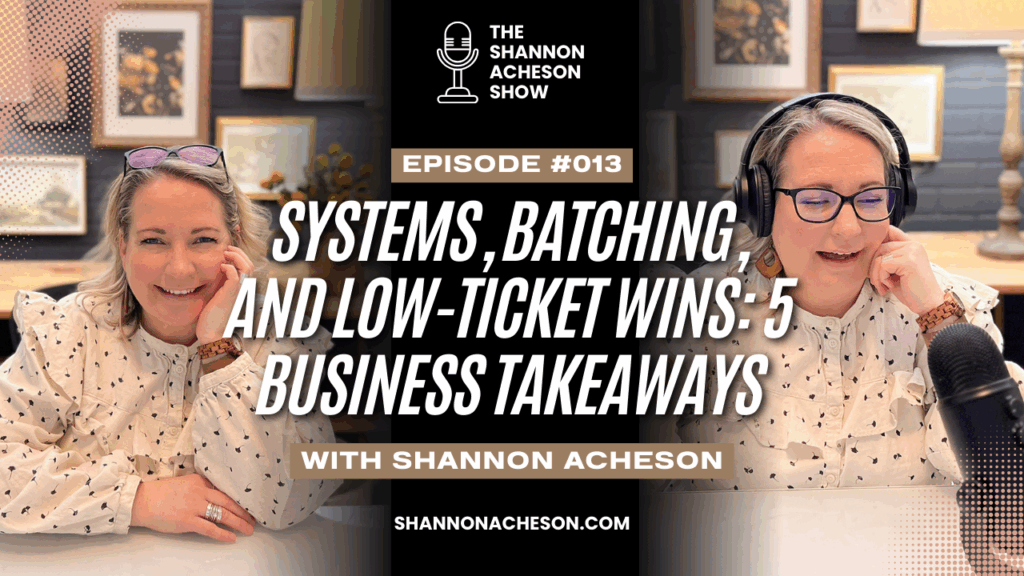
Recap & Debrief of Destini Copp Interview Wide graphic

Listen to the Episode Below

If you caught my interview with Dr. Destini Copp, you know it was packed with gems. If you didn’t, go listen — then come back here. Because in this recap, I’m pulling out the bite-sized takeaways you can put into action right away.

Key Points from This Episode

Start One-to-One
Working directly with people (done-for-you projects, coaching, consulting) teaches you fast. You get instant feedback, learn what works, and start to see exactly who your audience is. It’s not forever — but it’s the best place to start.

Rinse-and-Repeat Systems
Destini shared how monthly workshops became one of her repeatable systems. I’ve built SOPs for my podcast, so every episode follows the same flow. Systems mean consistency now — and something you can hand off later.

Batch by Task
Batching keeps your brain fresh. I batch graphics, captions, emails, and even recap episodes. Pair batching with systems and you’ll feel like a time-management rockstar.

Build Low-Ticket Digital Products
Start with the end goal in mind. Your freebie should solve one tiny problem, your tripwire should be the next logical step, and your order bump should expand that journey. When each step connects, selling feels simple and natural.

Prioritize Your Email List
If you’re starting fresh, make your email list your top priority. Use bundles, summits, and even ads if you can. Social media is great, but email is where the trust and sales happen.

Quotable Moments

“One-to-one is something you can really learn so much from because you’re getting direct, immediate feedback.”
— Shannon Acheson, 00:55

“Systems are super, super important. They help you with consistency and make it easier to hand things off later.”
— Shannon Acheson, 01:54

“Batching by task conserves brain power… when you pair it with systems, you can be such a powerhouse.”
— Shannon Acheson, 03:43

“Your freebie should solve one single, small problem. That should lead to a low-ticket offer, and then the next logical step.”
— Shannon Acheson, 07:17

“If you’re starting over, work on your email list first. Build that before you do anything else.”
— Shannon Acheson, 11:56

Links Mentioned in This Episode

Shannon Acheson.com

Freebie: Low Ticket Idea Bank

Freebie: 35 Ways to Get Traffic Without Google

00:00
Hello, thank you so much for joining me for this recap episode of my interview with Dr. Destini Copp. If you listen to that episode, awesome. If you do not go back and listen to that, it’s so good. There’s just a few things I wanted to pull out from that episode, from our discussion. I’m just gonna jump right in because these recap episodes are meant to be little tidbits, little bite size takeaways that you can learn from.
00:28
First of all, the first thing that I took out of my interview with Destini is that she learned so much by doing one-to-one. So that’s like done for you work, like doing a custom website for someone or working one-to-one with someone on coaching, walking them one-to-one. So not a group, not a make it once and sell it many times kind of thing, which is for me personally, the ultimate end goal.
00:55
But one-to-one is something that you can really learn so much from because you are getting direct immediate feedback from someone. So if you’re just starting and you are not 100 % sure of your niche or how to best serve your person, one-to-one is a really great way to start because of that. You can walk through and sort of customize what you’re doing for that person and then repeat that again with the next person and get a really good strong feel for who your audience is, who your person is.
01:24
what your niche is, how you can best help them. So one-to-one is great for that. Although it is not sustainable in my opinion, long-term if you want to scale and grow. However, great place to start. Lots and lots and lots of digital online entrepreneurs started there. um The next thing I wanted to take away from my interview with Destini is systems. You know, that episode was partially called Rinse and Repeat Systems that, um you know, you create the systems
01:54
that you need and you just use them over and over and over again. So for Destini, she does monthly workshops that sort of give up-to-date teaching, but she does that over and over again. So that’s a system that she puts in place. Other systems can be things like standard operating procedures, which we talked about before. for example, I have standard operating procedures written out, SOPs written out for my interview podcasts and what I need to do for those. like,
02:22
everything from coming up with the questions that I’m going to use as a rough outline with the guest to em how many social media clips I’m going to pull out of Riverside when I do the podcast episode to, you know, when I schedule my YouTube video of the episode versus when the blog post goes live or when the podcast goes live. So there are standard operating procedures written out for those, which are systems that mean that I can do that.
02:51
right now while I’m running this podcast by myself without a VA or anything, but then I can also take those systems and pass them along to a VA who can then take the podcast after I’m done recording it and look after those things that I will no longer have to do eventually down the road. systems are super, super important.
03:14
They help you with consistency because when you know, when you sit down to what you’re going to be doing, everyone that I’ve talked to has this to some degree, whether that’s what their days look like, or, you know, like Destini, what her systems are in place. So systems that are rinse and repeat. So you just can use them over and over and over again. Sometimes you might have to tweak them a little, but excellent systems. Next that goes hand in hand with those systems is batching by task.
03:43
I have, when I am functioning at my best with my other blog, Home Made Lovely, and even this one, shannonacheson.com, I batch by task. It conserves brain power, especially now that I am sort of paramount of puzzle. Brain power comes and goes. so batching by task means that I can totally focus on a specific task. Say it’s creating social media graphics for Homemade Lovely.
04:11
I will do them for shannonacheson.com at the same time because it’s the same part of my brain being used for those. I will come up with captions for each one at the same time or one right after the other because I’m working on those things together. If I need to recap episodes like this, I am at my best when I can batch those. I can sit down and go over.
04:35
uh my notes from the podcast interviews and record several recap episodes in a row, because my brain is working on the same thing. So systems are super powerful and they are extra, extra powerful when you em pair them with batching by task, right? So that’s also things like writing your newsletters or creating your content or client. m
04:59
coaching or group coaching or getting back to clients or customers or students, depending on what you teach and what you’re doing, when you batch those tasks, so replying to emails, replying to social media comments, when you batch those together with your systems, you can be such a powerhouse and such, um it is so good for your time management, it’s amazing. Okay, and the last thing I wanted to take out of my Destini Copp interview from the other day.
05:25
is that when you’re creating low cost digital offers or products, which I am a huge fan of, have had these with Home Made Lovely. Homemade Lovely is 15 years old this summer of 2025. It’s 15 years old. I have had low cost digital offers to go with that for at least a decade. So everything from back in the day, I had a self-published digital book about, actually you could get it printed on Amazon too, like,
05:55
one off at a time, print on demand, there we go, called bloggers and brands because I had been working with brands so much through Home Made Lovely that I was teaching other bloggers how to do it through this book called bloggers and brands. I then, my very first self-published book for Home Made Lovely was called Welcome Home. And the actual sort of start of my fully traditionally published book, Home Made Lovely from 2020 was based on
06:23
the very beginning Welcome Home book. Since then, I’ve created other courses. All of mine have pretty much fall under the low ticket price point, as in most of them have been around between $20 and $100. I don’t go all in for like thousands of dollars for a course because I don’t think it’s necessary for what I teach, especially through Home Made Lovely. But
06:50
But when you’re creating a low ticket digital product, especially if you’re listening to this and you’re a blogger who has lost income or revenue because you depended on ad revenue for a long time for your income, low ticket digital products are an amazing, amazing, amazing place for you to start. And I always say that you start with what your audience needs, what problem can you solve for them? But one of Destini’s sort of points was,
07:17
What is the end goal? What is the ultimate, ultimate, ultimate thing you can help them solve and then back that up? What should the lead magnet be or the freebie or the opt-in, whatever you wanna call it, what should it be? And a freebie opt-in, like we used to create them, I feel like in blog world, we used to create them as just whatever randomly came to our brain to get people to sign up, regardless of what that led to later or didn’t most of the time.
07:46
So your lead magnor, your opt-in should solve like one single, single one, only one um small problem for your person. It should kind of wow them and go, yep, okay, yes, this is really good, but it should still be, they should still be able to implement it or take action on it within like in a couple of hours at most. That should lead to a low ticket offer, which I love to do as a tripwire. So that means, m
08:15
as soon as they’ve signed up by email, after they’ve submitted their email and their name, it flips to a page that says, hey, your freebies ready, it’s gonna be in your inbox shortly. But in the meantime, this is your chance to get my XYZ product that is very tightly related to the topic and the solution that was in the freebie for a discount for the next 30 or 60 minutes. So.
08:42
That product can be always available, but at the regular price in your shop or whatever, or by email later. But in this instance, they have 30 to 60 minutes to take action and grab this tripwire. And most of the time, something like this is, say it’s a $27 product. Well, you’re gonna knock like 15 or $20 off, and it’s like a deal for them to get, like a no brainer.
09:06
You can make okay money with just that tripwire, but the next recommendation for that is to have an order bump. And the order bump comes up in the cart um while they’re purchasing this thing that you’ve put in front of them after the freebie. And the order bump is the next immediate related step. know, some examples of these are like how to get your baby, if you’re in the sleep space, baby sleep space, how to get your baby to sleep. um
09:36
without their blanket or their blankie, whatever. And then the next related step would be how to get your baby to sleep all night. And then the next one would be like the full sleep training thing of how to get your baby to nap when they should, how to get them to sleep all night, like the full thing. I’m not in that space, so I am like totally just spitballing that idea. For me, it could be something like how to make over a room in five steps, like with…
10:03
without buying anything, right? So that could be the freebie for Home Made Lovely. How do you, you know, fix this one room that’s bothering you? So that solves one thing. You tell them how to do that. The tripwire could then be, okay, now let’s find your style so that you can decorate better through your whole house. And then the order bump for that could be your entire course, like it is for me, on how to…
10:30
decorate your whole home step by step with repeatable steps that you can repeat in every room. So that would include things like how to choose colors, how to lay out your furniture, how to, um you know, all of those things. For shannonacheson.com, have one, I have a low ticket idea bank, which is a hundred, literally a hundred ideas for low ticket products. That’s my freebie. um It’s niche, it has several niches in it with several very specific, not just general like,
11:00
Give them a PDF, give them a voice file, whatever. No, these are very specific, 100 specific ideas for several different niches. My tripwire from that is actually my offer starter kit, where I will tell you within a couple of days, like five days, how to choose your idea, whether you’ve got lots of ideas or none, choose your idea for a freebie, or sorry, for a low ticket offer, and then how to create it.
11:27
and then have it already. And then my order bump from that is the sales page because the next thing that they need to know after they finally created their low ticket offer is how to write the sales page to sell the thing. So that is how low ticket digital products should work. The end goal should inform every step sort of in a backwards fashion and everything should be very tightly related. Okay, and my last point for my Destini Copp interview was if you are starting over,
11:56
Destini’s idea is to work on your email first. So that means build your email list first. You can make the time to share on social media, you can do all of that, but the first place that Destini, and honestly, I’d have to agree with her, would recommend that you start is to build your email list. Because once you have your email list, you can share all your content, you can share your products.
12:23
you can even more importantly than that initially is get feedback, um send surveys, send simple questions like what is your most pressing problem with your business, things like that, or whatever it is that you’re talking about um with your business when you’re starting is, you know, that email list is gonna be super key to that. And the ideas for growing that list, I mean, I have lots of them. um SEO is not the only way to get traffic and get eyeballs on your stuff.
12:51
But here are three simple ideas. One is bundles. So participate in bundles. That is you create a small product, it gets added to a bundle, people get sold that bundle um for a discounted price compared to what the price of all the things would be together. I know lots of you have heard of, for example, Ultimate Bundles. There’s some other companies that do things as well.
13:13
um The second thing is summits. That’s where you do typically a prerecorded video about your topic. It gets added to other ones. People get access typically to this summit for free and they can buy an upgraded all access pass so that they can have access to all the videos forever versus just for the days that the summit is live. And then a third way to get eyeballs on there is to do Facebook ads. If you have budget, you can… um
13:40
know, put your freebie in a Facebook ad and add people to your list that way. So there are tons more ideas of that. I actually have some more on the shannonatcheson.com blog if you want to check those out. But those are my takeaways from my Destini Copp interview. One-to-one helps you learn so much. Systems, especially rinse and repeat systems that you get just down to a science, are so helpful. Batching by task um paired with those systems just really amps up your time management and getting things done.
14:09
and enables you to be so consistent, which is huge, huge, huge when it comes to content and staying in front of people. And then creating low ticket digital products, you need to ask yourself what the end goal is and work backwards from that. And finally, if you are just starting or if you’re starting over, work on your email list and figure out a way to get highly qualified people from your niche onto your email list. That’s it. Thank you so much for listening.

Similar Posts

Leave a Reply

Your email address will not be published. Required fields are marked *