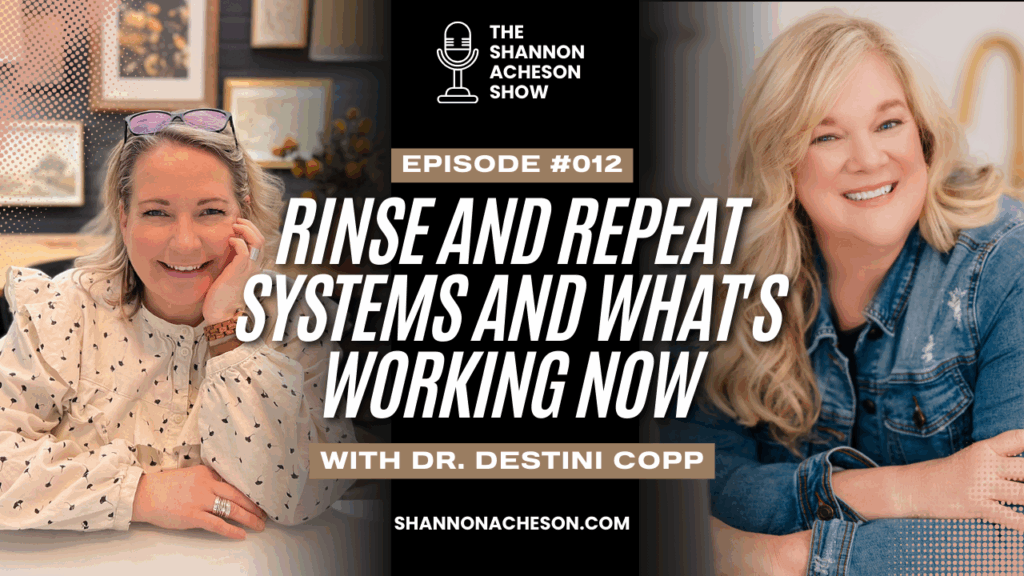
Ep 012: Rinse and Repeat Systems and What’s Working Now – with Dr. Destini Copp
Watch the Interview
Listen to the Episode Below
Building a business that fits your life? Sounds dreamy. But actually pulling it off — without burnout, without chaos — that takes strategy. And a little trial and error.
In this episode, I chat with Dr. Destini Copp about rinse-and-repeat systems, why she ditched done-for-you services, and how she built multiple memberships that serve her audience and her real life. We talk about smart funnels, sustainable content, and how she’s using AI tools to support her people — without adding more to her plate.
If you’ve ever felt pulled in too many directions or wondered how to scale without working 24/7, you’re gonna love this one.
Key Points from This Episode
Destini left a cushy university role to start her own business — after wanting to do it for 15 years. She jumped in with coaching and service-based work to learn fast and earn faster.
She ran Facebook ads for clients… until it wrecked a vacation. That moment pushed her to shift from client work to scalable digital products and memberships.
Her business now includes multiple income streams — memberships, Shopify stores with digital products, live workshops, and smart funnels (including paid ads).
She runs 3 memberships without burnout by ditching community platforms and answering questions via a private podcast and a weekly form. Members can also upgrade for Voxer access.
She only does live calls once a month per membership — no weekly content churn. Everything else is systemized and runs on a clear rinse-and-repeat schedule.
She uses batching and themed workdays to stay focused. Wednesdays are for member support. Mondays and Tuesdays are for content creation. Thursdays and Fridays for newsletters and workshops.
She’s still hands-on with marketing — because no one else can communicate her message the way she can. She uses AI to speed it up, but the ideas and strategy come from her.
What’s working right now? Live webinars. She’s moved away from evergreen funnels because showing up live once a month converts better in 2025.
She’s integrated AI deeply into her memberships — from custom GPTs and onboarding bots to private podcast Q&A, accountability texts, and growth plan feedback loops.
If she had to start from scratch again? She’d use summits, bundles, and collaborations to build her list fast — and lead straight into low-ticket offers with a clear path to her bigger programs.
Quotable Moments
“I came back from that vacation and I said, never again.”
— Dr. Destini Copp, 06:34
“People are craving that live support. They don’t want just an informational type course and then the expert’s not there.”
— Dr. Destini Copp, 11:51
“The strategy for somebody with 70,000 subscribers is very different than someone with 200 — and you have to meet them where they are.”
— Dr. Destini Copp, 21:06
“I don’t think any agency could take my voice, my thought leadership, and really get that message out into the world the way I can.”
— Dr. Destini Copp, 28:13
“I really truly believe that we all need that tripwire type funnel.”
— Dr. Destini Copp, 33:25
About Destini
Dr. Destini Copp is a business growth coach and digital product strategist. She helps business owners turn their digital products into consistent, scalable revenue using growth flywheels and AI-powered systems.
Links Mentioned in This Episode
Dr. Destini Copp’s Website:
https://destinicopp.com
The Creator’s MBA Podcast:
https://destinicopp.com/blogs/podcast
Newsletter Profit Club
Membership mentioned in the episode
HobbyScool
https://hobbyscool.com
(Destini’s second brand focused on summits and digital product creators in hobby niches)
00:04
Welcome to the Shannon Acheson Show, real business talk for real life. I’m Shannon, creative business coach, digital product lover, and your strategy sidekick. I’ve built a business that fits my life, and now I help other women do the same. No hustle, no fluff, just smart, honest conversations about building a business that works for you. Let’s dive in.
00:29
Welcome to the show. am so excited today to have Destini Copp with me and we’re going to chat business and all those awesome things. I’m going to read you her bio by way of sort of an introduction and then we will just chat. Dr. Destini Copp is a business growth coach and digital product strategist. She helps business owners turn their digital products into consistent, scalable revenue, hallelujah, using growth flywheels and AI-powered systems. Welcome, Destini. Thank you so
00:59
for joining me on the show today. thank you, Shannon. Thank you so much for having me. I am super excited to be here and chat with you doing one of my favorite things chatting on a podcast. I love it too. It’s one of my favorite things to be a guest on a podcast too. And now with this new show, like doing the interviews, it’s, it’s so different, but it’s so fun to get to like hear everybody’s sort of business brains is like one of my favorite things ever.
01:25
Yeah, I mean, literally, I could sit here and talk with other entrepreneurs all day long. Like, I love doing this. Yeah, it’s so good. It’s like, that’s one of the reasons I started doing this. I don’t know how much.
01:37
you know, my other business is Home Made Lovely and like I’ve had that for 15 years. It’s sort of decorating and organizing and stuff like that. And being in business for that long, like, oh my gosh, like I wanna do more of that. So that’s what sort of prompted this. Now you and I, like we’ve not talked like this before. We sort of, I think.
01:57
We connected because I was like in one of your summits, think recently this year. I think that’s how we sort of connected. I think so. Yeah. So we probably in hobby school, we do a lot of online learning virtual summits and hobby school and all types of niches. And I meet a lot of entrepreneurs over the years because we do a lot of those events and you know, we just love helping kind of promote other business owners in that regard. Yeah.
02:26
No, that was great. Yeah, it was so cool to do that. So, okay, so let’s sort of rewind a bit. What were you doing sort of before you started or when you started your first business and what sort of nudged you into being an online entrepreneur? Like what got you started with that? You’re laughing, I don’t know. Well, I kind of love this question. Okay. Well, you know, kind of a windy path, that, right, that’s kind of what it is for everybody. Like I wanted to start my own business.
02:55
like probably 15 years before I actually did. So if anybody’s like listening to this and they’re like, should I, should I not? I wish I had started way, way sooner than what I did, but that’s just life, right? We had, you know, jobs and families and kids, and I never really was able to kind of, you know, take that, you know, jump, if you would. So I worked in higher education for many, many years, lot of different type of roles there.
03:24
Assistant Dean, Vice Chancellor of Online Operations, just a lot of different roles I’ve taught for many, years. I’ve been teaching online since 2005, but I always wanted to start my own business. That was kind of my itch, if you would. And I’ve always worked in marketing, my doctorates in marketing, I have an MBA in marketing, undergraduate degree in accounting, but that’s…
03:49
another story. But I, you know, so I really wanted to get out there and help other online business owners kind of, you know, with, with their marketing. And I was like, you know what? I am going to do this. I’m going to leave my job. I left a pretty, you know, cushy like university level job and, know, kind of just went out there and took the jump and started my own business. And that’s kind of how I got there. If you would.
04:17
Okay. Oh my goodness. Yeah, that’s like, that’s the thing. I think when you go to start, it’s, it’s, it’s a bit of a scary step and yeah, for sure. I hear all the time, like, I wish I started sooner, right? So yeah. So when you started your business, was it always your plan to have, you know, multiple income streams or did that sort of evolve over time? Most definitely evolved.
04:41
So right now, I think I was counting it up the other day. I have around seven to eight income streams. But when I first started out, I just started out with one really. One income stream and coaching and kind of doing kind of service-based work. that’s for the most part, that’s kind of where I recommend a lot of people start. Because I think you learn so much when you’re working one-on-one with clients.
05:08
rather than jumping in and automatically creating a course or a membership or some type of program like that. When you’re working with people one-on-one, you’re learning so much. And that’s generally where I recommend most people start, and that’s why I started. It’s one of the fastest ways to income right away too when you’re starting, right? Because you sit down and you do that one-on-one, and it’s faster than sort of the snowball of other things.
05:34
Yeah, and there’s so many people out there who are looking for your help, like your personal help. And they need kind of that one-on-one, know, I’m gonna help you sit by next to you and help you do this. So there’s a lot of opportunity out there for that. Yeah, no, I like that. That’s a good one. So which of your businesses actually came first and sort of what made you choose that? So coaching, obviously, but like then from there sort of what made you choose?
06:02
Yeah, I mean, it just over, you kind of evolved over time. So I started out with kind of the coaching and the service based work. I got into Facebook ads consulting. So I was working with clients and if anybody’s ever been around me, they’ve heard the story of kind of what happened there. I was on vacation with my family, you know, several years ago we were at Watercolor Florida and I had a client whose Facebook ads.
06:30
wasn’t doing as well as he thought they should be doing. And you know how Facebook ads have been over the years. So it really kind of was, he was upset. So I had to stay back. My family went to the beach. I had to stay back and work on the Facebook ads. And I came back from that vacation and I said, never again. And that’s when I kind of went full force into creating digital products and courses. you know, now I have like,
06:58
three memberships, I have two Shopify stores filled up digital products. We do a lot of digital products in both of my brands, but I started out in my personal brand, started doing all of that. And then a few years down the road, that’s when I bought the hobby school domain. And I was like, you know what? I think I can do something with this. Like I think I can build something pretty special with this. And that’s when I, you know, kind of branched off into that brand. Okay.
07:27
Oh my goodness. that was, was that more on purpose or was that sort of following breadcrumbs? Cause you said you bought the domain and you went, well, like. It was, so I bought the domain and with the understanding, this is a pretty cool name, know, it’s hobby school without the age kind of, you know, it, actually found it through one of those domain name generation.
07:52
generators and this was way before AI was even out there. So it was like, I was just playing around with it. I’m like, okay, that’s pretty cool. I sat on it for about a year, maybe a year and a half. And I was like, you know, I don’t know exactly what I want the business model to be. thought one, at some point I could basically put up like a marketplace where people could put their courses on it and I can market there kind of like an app sumo, but for like people in the hobby type niches.
08:22
I started out doing like paid bundles, which I love bundles, love paid bundles, but it really wasn’t growing the business and the revenue the way I wanted it to. And I had done some virtual summits in my personal brand. And I was like, you know what? I’m going to try that business model with this. And we started out doing almost a virtual summit every single month.
08:48
Oh my. And it was a lot, right? You know, we got our process down, you know, we started finding people to collaborate with and it really did take off. Like I, you know, kept doing them. I kept getting better at them. The marketing got better, you know, and we started building that particular brand that way. And, you know, come now in 2025.
09:11
I’m not doing as many. We’re doing five this year in hobby school and next year I’m probably even going to move that down to four. But I feel like we have a very, very solid process in a business model, both for our speakers, for the people who are attending all of these events and for us, for our business model. That’s awesome. That’s so good. It’s so neat to hear that you started one way and sort of pivoted when you realized it wasn’t quite doing what you wanted it to. I love, I love, love, love that.
09:42
If you had to, so if you had to strip it all down and start with just one offer again, what would you, what would it be?
09:51
So knowing, this is actually a very good question. think an important question based on where we are right now in the world of AI. And I think a lot of things have changed. And I noticed this change coming in the digital product world and kind of, you know, just create, or I’ll just talk about this creator world that we all live in. I noticed this change about a year, year and a half ago. And that’s when I made a lot of changes in my business.
10:20
because beforehand I was doing kind of more, you know, courses, more informational, you know, educational type courses, right? I’m a teacher, I’m a university professor. That’s what I do. And I still teach at the college level. So that’s what I do. And that’s what I was used to. But what I have noticed in the past year, year and a half is we have definitely been moving away from those type of models. And…
10:48
So basically the changes I made and where I generally suggest that people start if they wanna get into like, I’ll call it more passive income type models, but it’s not really passive is I love the membership type model. And I really feel like with the three memberships that I have launched like in the past year or so, year, year and a half, I really feel like it’s a very solid model for me, might not work for everybody.
11:18
But here’s what I like about it. I do the monthly live workshops. So things are just changing so fast in the world that we’re in, right? And I feel like with the monthly live workshops, I can get feedback from my members on what do they need help with, right? What do they need help with right now? So we do a workshop on that. I gather their questions. I pull them on all the workshops just to make sure it was very relevant for them. And they can come to the live workshops and get.
11:47
real life, you know, real life support for me. So people are craving that live support. They don’t want just an informational type course and then were the experts not there. So that’s what I did. And I added some other elements in there, but that’s basically the gist of it. There’s also a private podcast. There’s a lot of other types of support in there with AI and that sort of thing. But really what I think people are looking for is support from the creator.
12:16
like you and like me. Right. Which does make it a little bit like, for me, I find that a little bit tricky and I’m just wrapping my brain. Like I’m so awesome that you sort of wrapped your brain around that like a year, year and a half ago. I’m only just wrapping my brain around that now I feel like. Because I, well, while I’m not, I don’t have a master’s or a doctorate, I am a teacher at heart. I homeschool my kids. That’s just naturally how.
12:42
I explain things, I do things, I’m a teacher at heart. And so for me, my brain goes, but I taught it already. I recorded it. So what now? So to hear you say the sort of extra support, but then still hands off, I feel like that’s a tricky thing to do. Like not hands off, the passive income, right? Which we all know isn’t completely passive, but like how do you…
13:09
balance those two things? Like you said, you do a live once a month. Do you find that that sort of, does that balance? Like it gives you enough, you you’ve done the work, you sort of, there’s the teaching component sort of done, but then you’re answering questions once a month. Is that sort of what you’re doing? Yeah, so I’m doing a little bit more than that. So we have the live workshop a month, which is very curated based on what they need help with. So they can come to that and get questions live.
13:38
They can also submit their questions beforehand and I can answer them. The other thing I do they can ask or ask I should say questions at any time. So they go to a forum they can submit their questions and I will answer them via our private podcast feed. So I have basically Wednesdays are my day where I do like support for my one on
14:01
I do have some little one-on-one clients too, but that’s when I go in and answer any questions that have been submitted via the private podcast feed. And if somebody has upgraded, so people can upgrade, I do Voxer coaching. Okay. So they can go in and ask, you know, basically ask questions there too. So you’ve got that down to like sort of one day though. You’re not like answering questions like 24 seven on weekends, all of that.
14:29
Right. So I elected, and this is just personal for me, I elected not to put a community out there. So I don’t have this, my memberships in Circle or Facebook or school or anything like that because I didn’t want to feel pressured because I’m just like an overachiever, like all of us are, right? We want to make sure that we’re answering people, they’re getting their questions answered.
14:55
And I knew if I had like a Facebook group out there or some type of community like circle or school, I would see a question there. I’m like, oh, I gotta answer it or answer it before somebody else does if they answered it wrong or something like that. So I decided not to set up my, you know, memberships like that and they can submit their questions.
15:15
via the form that I mentioned, or if they have the upgrade for the one-on-one boxer coaching, they can do that too on Wednesdays. But basically, Wednesdays is my kind of client support type day. Okay. So if they fill out a form, obviously you’re setting expectations ahead of time. If they fill out the form with a question on a Monday, they know that you’re not getting back to them till Wednesday. Is that sort of… Yeah. Basically for the forms, I’ve told them a week.
15:43
It’s generally what I like to do. Sometimes I’ll go in there and answer them early. It kind of just depends on my schedule and how easy that question is. Some questions I have to kind of dig in and do a little bit more of an audit for. Some questions I just know off the top of my head. Okay. so when you’re, sorry, I’m super curious about this. So when you’re doing a private podcast answering them back,
16:08
Like I’ve seen private podcasts where it’s like this list of five episodes and it’s sort of almost like what an old school email sequence would be, but it’s in podcast format. So when you’re saying you’re answering them back in a private podcast, is that because you don’t have like the Facebook sort of other group or community group where everyone can see the answer, but by doing it in the private podcast, everybody can see that answer? Is that sort of That’s the goal there because generally what I have found is one person has
16:36
that question. There’s probably, you know, 50 other people that have that same question. So when people, you know, ask their question, I always give them the option. If they want to stay anonymous, they can. Most people will be like, I don’t care. You know, you can mention my name. could, you know, give them anything you want about my business. But if they are, you know, feel uncomfortable, I’m very respectful.
17:04
in that manner, but I do answer it on the private podcast so that anybody can hear the answer. And do you like literally just go and answer it do you like make it? don’t, I don’t, that’s just super, it’s super neat to me. I’ve never heard of running a community that way. And maybe that’s just my, not a community, a membership that way. Cause it always seems to involve a community component somewhere. So that’s super neat to me. Like, I don’t know.
17:34
Yeah, so, you know, a lot of my members, they are not looking for another like circle community or Facebook community or school community to go in and ask questions in. You know, when they submit their questions via that form, and it’s just a Google form that they go fill out, you know, I will get that.
17:55
I did a couple this week where I went in and reviewed probably four or five emails that they had sent out. looked at their open rates, their click rates. I clicked through, went to their website. So I did a pretty in-depth review of that particular situation and gave them some insights into what I would do if it was my business and responded via the private podcast. it was…
18:20
pretty in-depth review in terms of giving them feedback that would be extremely beneficial for them. Right. Okay. That’s really cool. I don’t know if, I mean, other people might be doing it, but I’ve never heard of that. So that’s, I like that because that’s like, that is personalized feedback, but you’re right. You’re not on all the time. don’t have to, because it’s a podcast, you don’t necessarily have to go do your hair and makeup to be on video to like, right? Like to walk them through a loom video or something like that. Like,
18:49
That’s a really, really good way of doing that. I like that. Yeah. Well, thank you. Not that you need my approval, but. Yeah. Yeah. So I really set it up that way, you know, a lot just to meet the, you know, the needs of me and my business and my life cycle. And I knew for me to stick with this and for it to be successful and for me to feel good promoting it, I knew what I needed to do there. Right. And so, so membership wise, like I’ve
19:19
I’ve had a membership a couple of times and it didn’t last long actually, truthfully, in my Home Made Lovely business because the only model I knew or had been exposed to was you have to teach something new like every week kind of thing. And I was like, but I already wrote the course. Like the information’s already there. so yeah, so membership wise, you’ve structured yours very differently.
19:41
Is it a standalone sort of they have access to you but they have to have had other products that you have in order to have like that base level of your teaching or your knowledge or is it dependent on which business it is, which membership it is? No, mean any of them people can join at any time. they don’t, you know, they don’t need to purchase something else or anything like that. And the thing is, the reality is people are all at different stages in their business.
20:11
And it’s almost impossible to get everybody at one particular stage no matter what course you have. Right, right. Which makes the memberships that are based on teaching something new all the time a little bit tricky because not everybody’s at the same place. Whereas it seems like the way you’ve structured it’s more like they come to you for the access and the help that you actually give them on a one-on-one but not one-on-one, if that makes sense.
20:40
Yeah, mean, truthfully, when I look at the members, I’ll just use the newsletter, Profit Club, as an example. I have people in that membership that have 70,000 people on their email list. So I’m working with them and giving them suggestions on ways that they can monetize that particular newsletter better. And then I have people that come in and they’re like, that’s me, I only have 200. I’m really just getting started. The strategy for somebody like that is very different.
21:08
I have to kind of like point them to different resources and say, you know, here’s where you need to go. And I have all of this set up, you know, just to kind of guide people on where’s the best place for them. But there is, there’s a lot of different people and there’s people at, you know, 30,000, know, 15,000. And like I said, people who are just getting started. Right.
21:30
It sounds like you have a great handle on how to run a membership that works for your people and that works for you for where you’re at in your in your real actual life too, right? You’re not a slave to what this is doing. Okay, so you’ve created and sold, I’m pretty sure courses, templates, memberships, sort of, I think you kind of answered this, but also what’s, what have you found to be the most sustainable and aligned for you? Like particularly in this season, but in other seasons too, like what have you?
21:59
found to be the… Yeah, so definitely the memberships. The memberships are working for me and my lifestyle and I feel like my students and clients are getting better results than they would if they were just buying like a template or a course. So definitely that. I will say that for me, I did not like…
22:23
Basically the one-on-one type work and I have done that in the past. I’ve built like funnels for people Obviously, I was doing kind of the Facebook ads consulting which is more like service-based work. know yes that you know, I’m not saying that you know I’m just saying that for me personally. It’s just not what I wanted to do and I realized that you know pretty quickly As I got into and I’m like, no, I’m gonna do something else. It just wasn’t working for me. It’s not very scalable
22:52
either, right? Like if that’s where you’re starting, that’s great. Like if that’s where someone needs to start in order to make earn money. But yeah, it’s not scalable long term to do done for you services like that. Yeah. Yeah. But you learn a lot. there is a, you know, there’s and cons to it. You learn a ton doing that. It’s true. Which is, which is why it’s not necessarily a bad place for someone to sort of not start, but start.
23:19
Right? Because then you learn lots and then you can go, oh wait, no, this isn’t for me, but I learned all this, so let’s go do this instead. Right? Yeah. It gives you a lot of insight into what you want to do next. Let me just put it that way. Yes. And that’s, and so to be clear for the list, for our listeners, that’s the done for you service versus one-on-one coaching. Because those are two different.
23:41
Very two different things. I I still do one-on-one coaching. And I love it. Like I love working with people in that matter, but that’s not, yeah, it’s definitely not what we’re talking about here. Yeah, no, no. Yeah, two different things. So, okay, so I’m kind of dying to know, like you have all these things, all these different businesses, all these different memberships and all the different things. How on earth do you structure your time to manage all of that? Like, do you batch it? I know you said Wednesdays are, you know, that.
24:10
But do you batch the other things? you buy business, buy task? How do you manage your time with all that? Yeah, so that’s a really good question. And definitely, I batch. And I batch it by task. So just to give you some examples, like.
24:29
you know, Thursday, sometimes Fridays would be the days that I would write my newsletter. So I do, you know, a newsletter for hobby school. do a newsletter for my personal brand, which is the creators NBA newsletter. And then I do newsletters for all of the memberships every single week. That’s, that’s another thing that kind of keeps them updated and kind of guides them. this podcast, you know, just launched this private podcast just launched, or I’ve launched this other tool in there and the membership for you.
24:57
So I do that every single week. On Mondays and Tuesdays, I would consider that to be more of my content creation type days. So maybe I’m doing, you know, my podcast or blog or putting together content for any of my workshops and that sort of thing. I try to do the workshops on Wednesdays and Thursdays. So I, you know, kind of those are my days to do those.
25:25
The other thing that I do in terms of promotion because, know, lead generation and promotion is very important. That kind of fuels everything you’re doing. I do some collaborations, bundles and summit participations, but this year I’ve moved more into paid advertising just to kind of get that recurring leads into the business.
25:51
The other thing that I have found is, or what’s working right now in 2025, I should say, to get conversions, to kind of get people into your programs, is the live webinars. So I’ve done a few of those this year. I’m doing three this month for every single one of my memberships. And beginning in August, I’ve just made the decision, I’m just gonna do one live webinar for each membership every single month. That’s what’s working.
26:21
So I have a pretty rinse and repeat model to be honest with you. So I just have this system set up and this is works for me and I just run it basically every single month. That’s good. So consistency in doing all those things when it’s needed, right? Yes. Okay. So do you have a team now and what was the first thing that you outsourced that sort of made a big difference?
26:50
I do have a VA has worked for me for probably four years now, maybe a little bit more, maybe five. And she handles most of the hobby school type stuff, like the virtual summits, working with the speakers, setting all of that up. I really don’t have to touch that. So she’s, you know, kind of taken on that. She helps me in some of the other areas, but a lot of the…
27:16
marketing that I do personally, like I set up my Facebook ads, I get my stuff ready for the webinars, I have the sales funnel set up for that. Any like that kind of stuff I’m generally doing. Right. So, and is that, I guess, what is my question about that? So do you deliberately do that stuff because you like it because you don’t want to pass it off because? I think in general,
27:45
I think most of us need to be doing our own marketing. mean, we’re not a huge firm, right? We’re not an Amazon out there. We’re not making millions and millions of dollars a year. I think most of us, need to be doing our own marketing. I mean, if I was outsourcing a lot of this, I really don’t think it would be as successful as it could be, even if I was outsourcing.
28:14
to like a marketing agency, I really don’t think that they would be able to take kind of my voice, my thought leadership knowledge and really get that message out into the world the way I can. Because I have very specific kind of thoughts and opinions on that and it would be almost impossible for me to outsource that. Yeah, things like that I absolutely agree with because it is really hard. No one else is in your head. No one else knows how you would.
28:43
word something necessarily or whatever. And I think, you know, it’s, I’ve read or what I’ve just absorbed that like people kind of know the difference when it’s you talking versus when it’s not right. they, yeah, can, you know, and I’m obviously a marketing. I’ve worked in marketing for close to 30 years. I don’t think that any agency out there could basically take like my sales page for one of my memberships.
29:11
and do a better job with it than I have. Now, obviously I use AI to help me in that regard. It definitely fast tracks. So, you know, getting that done for sure. No doubt about it. But I just don’t think an agency could do it as well as I could. That’s fair. Totally fair. So you teach other people how to create digital products. What mistakes do you see people making when they’re just getting started with digital products?
29:42
So, it’s a little bit of a loaded question, but I’ll try to break it down a little bit. When you’re first going out and you are wanting to kind of dip your toes into digital products, there’s a couple of things that I like people to kind of keep in mind. One of the best ways to sell what I would define as low cost digital products
30:07
like mini courses, planners, journals, that kind of stuff. I’m not talking about a $2,000 program where you’re gonna be supporting them, coaching them, what have you. I’m talking about more like a $47 mini course that might have some quarter bumps or something. The best way to kind of dip your toes and create them would be to understand
30:35
where you want to take that customer on the journey. Like what is that end goal? Without that end goal, it’s very hard to kind of put together these upfront products. So let’s say that your goal is to enroll them in a coaching program with you. Maybe it’s a $2,000 program, thousand, whatever. That’s kind of irrelevant, but your goal is to enroll them into that program. You kind of got to back up from there.
31:05
you gotta figure out what the lead magnet should be. That’s very important, because that’s gonna help you attract your ideal customer. And then from there, you can kind of build out some low cost digital products to kind of dip your toes in. You can think about like a mini course. So what would be the next step after the mini course? That could be what we call a tripwire offer. So they sign up for your lead magnet.
31:29
that on the next page you have this special offer that says at the top, wait before you go, I have this special offer you may be interested in. It could be like a mini course. think like a course that has five video lessons, maybe some templates, maybe some AI prompts, some custom GPTs or whatever. Then they go to the checkout page. So from there, you can have another digital product, like a little order bump that might be $9. So you can kind of see where I’m going, but they all kind of tie in together.
31:58
So the biggest, going back to your question, the biggest mistake I see people making is they’re not creating all of this with the end in mind. Because your goal at some point is to kind of move them into your coaching program or whatever that signature offer is. It could be a membership or what have you. Right. So someone, so like it’s my sort of opinion that regardless of what your overall brand model is, you should have some sort of low ticket offer.
32:28
but it should fit into that funnel. Like it should fit into that overall plan. It should start with something that a lead magnet that makes sense. It should go to something that’s like the next sort of logical step. And then, and then from there it definitely should go into your bigger thing. And yeah, I think some people do lose sight of that and just go, oh, I’m just going to create this product in the middle of like, I mean, I know I did years ago, like in my other business that.
32:56
I didn’t think about it like that. And I think sometimes people don’t think about it like that. And you’re so right that you need to have that whole sort of ecosystem sort of in mind when you’re creating them, for sure. Yeah, I mean, you and I are thinking alike. I I truly believe that most online business owners like us out there, need to have kind of that trip. Well, I call it a tripwire type funnel. People call it different names, but it’s all the same.
33:24
I really truly believe that we all need to have that. And the reason why we need to have it, you’ll tell me if you agree with this or not. The reason why we need to have it, it just gives people a little bit of a taste of what it’s like to work with us in, you know, super cheap, no brainer type offer. They can test you out. And then if they really like what you did there, they’re going to be more likely to kind of move into that higher price signature offer that you have.
33:51
I do. I agree with that because I feel like people, you and I could say the same thing, but one person’s going to resonate with you and one person’s going to resonate with me just based on how they feel about us, how we talk, what are our eye color, like whatever it is, right? Like you can hear the same thing from like seven different people and one person, it will, you’ll be like, I like how that person says it, right? Like, so I feel like you’re right. Like the freebie gives them like this little bit and then the, the order bump or upsell, whatever you want to call it from the tripwire is
34:20
you know, a little bit more, right? And it gives them a little bit more of a concrete and they can go, oh yeah, you know what? I do want to work with you in this bigger capacity. I’m okay giving you a little bit more of my money because I’ve sort of got a feel for who you are, right? Yeah, know. Funnels are like from that freebie to tripwire to order bump and upsell and like, yeah, totally 100 % agree with you on that. Yeah. So do you ever feel pulled in too many directions running multiple?
34:49
brands and how do you stay focused or refocus when needed? I always, I do feel like at this point in time, I have like a, I’ll call it like a rinse and repeat kind of system, right? I know I’m to be doing three live workshops in each of our memberships every single month. So I scheduled those. I almost have them scheduled throughout December. So I know when those are going to be, so that’s done.
35:18
I know I’m going to be doing three live webinars, free webinars for people and run Facebook ads to them to move them. Right. So I have that done and I just do the same thing every month. I don’t switch off of that. I might make some books here and there based on the conversion rates and what have you and what’s resonating with people. But I have that. And then, you know, from a content perspective, I do my weekly podcast. So I have that set up.
35:48
I will answer questions from clients. So I have that kind of done. I do all that on Wednesday, like what we’ve talked about. And then we have like our summits that we do in hobby school. So I feel like it’s kind of a working kind of system, if you would. Yeah, yeah. So no, that’s good. So these are kind of strategy mindset questions. They follow together, but.
36:13
What role has evergreen income played in your growth and how do you approach launching versus evergreen now? So evergreen for me used to work better than what it’s working right now for sure which is why I have moved to more of a The you know just do the one kind of workshop every single month for every single membership That works better than the evergreen model for me right now, and it’s pretty easy right? I
36:42
I know I gotta show up for an hour, do that workshop and that’s that.
36:49
So in the past, what I have done is kind of taken that live kind of workshop that we did and basically put it in recording and just kind of did it that way. It’s not working as well as it used to be. I think people really want to see you live. They want to be able to ask questions live with you. Or they just want to know that you’re a real person. So I’m not against Evergreen.
37:19
Certainly not. I’ve worked on a lot of evergreen models over the years. It’s just not working as well as it used to. Okay. So you’ve been in this space a while, obviously. So all of it’s sort of shifting fast with AI and stuff, which we touched on a little bit, but sort of what’s your take on digital products and AI right now? What are you leaning into testing or taking a wait and see kind of approach?
37:49
Yeah, so one of the things that I think is really not a nice to have, but a need to have in our digital products right now are ways that our students can get to that result and that transformation faster. So there’s a lot of different ways that we can implement AI into our programs. And I’ll just go out and just give you some examples. If you’re interested, okay.
38:17
I’m going to go beyond just the custom GPTs and the AOMs because everybody, we know what that is, right? So everybody that needs to be in your digital products. If you didn’t know that you need to do that. Okay. So we’ll get that out. So a couple other things, one of the things that I have set up and I’ve actually set this up this week are accountability bots. So what I was hearing from my students that number one, like in the newsletter profit club,
38:45
I’m not getting my weekly newsletter done. I need more accountability. I said, okay, your wish is my command. So basically what I’ve set up is an accountability bot where they can opt in. So there’s like a word that they opt in and they can get a text on a certain day. And I have it set up to go out on Wednesday. So they get a text. And basically it’s that accountability person.
39:13
bot that I’ve set up saying, you your weekly newsletter? Do you need help? And then if you need help, have a, basically a custom GBT and AI assistant that they can click on and it will help them write it in 15 minutes or less. And then on Fridays, it circles back with them and say, did you write your weekly newsletter? Yes or no? If no, it will, you know, prompt them and it will help them basically write it, you know, write it out.
39:41
Same thing for the Digital Product Growth Lab. Send that on Monday. What are your goals for the week? What do you want to get accomplished? Do you need help with them? If they say yes, they need help with them, they click on it and I have basically an AI assistant that goes in and helps them outline their goals, but also put a plan together to achieve them. So that’s a couple of things. I have some onboarding AI assistant. So when somebody comes.
40:08
into the newsletter profit club. It will basically kind of segment kind of what we talked about earlier based on their goals. You know, have you know, what basically what are your goals? Have you done this? No. Okay, check this out that sort of thing. So it kind of pushes them to the right place in the membership. Have you signed up for the Provoke podcast? No. Here’s where you want to go to sign, you know, basically do that. So those are some of the things that I have set up. I’m trying to think what else.
40:38
We have a lot of these type of systems in there. One, another example, I’ll give you one more example and then I’ll see what questions you have. We do like personalized growth plans so people can submit their, you know, basically their plan. I have it go into, basically I have it back in system tied in to OpenAI. It reviews it, it sends their plan to me.
41:06
I get a notification via email. I look at what the AI has said. I looked at what they submitted. I might do a little bit more research on my own and then I will do a personalized video back to them. Those are just some of the ways that I, you know, we have kind of incorporated AI into our programs and I know there’s, you know, other ways that we’re still working on, but that’ll give you some ideas. That’s so what would you say? So first of all,
41:36
Is that like, those were examples, obviously. So did you, when you added those, did you add them like to your existing memberships, to your existing programs? Did you have people upgrade to get them or did you just add them in because you you make them once and there they are for a little while at least until you have to update them. Yeah. So some of, most of this stuff is just added into the membership. There are some like bonuses that I have created. Like I have created like a full blown like.
42:06
marketing AI assistant team that’s going to be part of the launch that I do this month. Okay. Um, like for the digital product growth lab. So if they do like the annual or lifetime plan, they will get access to all of that. Um, so yeah, so just different things like that. Okay. And are you going in and like programming and creating those things yourself? I am. So I do have a pretty, you know, high level technical knowledge. Um, and you know, it’s
42:35
not as hard as most people think. It’s actually relatively pretty easy. What I love about these, especially all, I love all the custom GPTs that I’ve created because I have trained them on basically my teaching philosophy. So I have uploaded like our transcripts and our trainings and all that in there. So it’s, know, it’s definitely does a good job training them. Yeah. Yeah.
43:04
I find the longer, I mean, I’ve worked with it, I’ve only worked with chat now for, I don’t know, a year and half, a year. But like, I feel like the longer or the more I work with it, the more clear it gets on what my teaching model, like what I teach and how I speak and stuff like that. So what would you say some of your favorite tools are then for AI things, for creating these things for your business?
43:30
So I use ChatGBT obviously for in the custom GPTs there. I used to use Claude like for the marketing, but I found like just in the past like few months, I feel like ChatGBT has gotten a lot, a lot better there. So I’ve been pretty, pretty happy with all of that. I’m trying to think what other AI tools I use like Luisbot.
43:59
for some of these. I have like a clone, like a newsletter kind of clone that has all of my teachings in it. And it can have conversations with the members there. I’m trying to think what else Zapier, we use Zapier a lot to kind of do that. We tie into OpenAI directly for a lot of the things that we have set up. Mobile text alerts.
44:26
is what I use for the mobile notifications, SMS notifications. I’m trying to think, there’s probably some more and I’m just not thinking of them right now. No, that’s fair. I was just curious. So if you had to start over right now with your current knowledge but no audience, what would you do first?
44:47
current knowledge, but no audience. So, I mean, my first goal would be definitely to start building my email list. And how would I do that? I think I would move into doing it via bundles and summits. If I had the budget, I’d probably do some Facebook ads too, but, know, clouds, I think, and using other people’s audiences are the…
45:14
Fastest way to grow is definitely a served as well in hobby school. No doubt about it Mm-hmm. No that absolutely makes sense. And what would you of all the things you’ve done? You sort of answered this already with the done for you stuff, but like what would you definitely not do again?
45:32
Definitely wouldn’t do Facebook ads consulting again. I hated that. I don’t even like working on it for my own business. So why in the world would I would have do that for somebody else’s business? I it’s making a whole lot more straightforward and simple. my word. Definitely not that. I love coaching. So I would always do that. I’ll actually I love my memberships. Like I love teaching and I love teaching live. I mean,
45:59
Do I like having to get dressed up for Zoom and everything? particularly, but it is what it is. But I do like the interaction with people. And I think I missed that over the years when I wasn’t doing it as much. So I actually do enjoy that. Yeah, fair. No, I mean, I love conversations like this, but yeah, the whole.
46:21
putting on makeup and doing your hair, it’s like, come on. I did put on makeup for you today. I don’t normally do this, just so you know. So what is one tool or software you absolutely can’t live without? One tool. So just one. I mean, I don’t know if I could come up with just one. I’m sure there’s lots. There is lots, right? can have more than one if you want. I mean, I would say that
46:50
Thrivecart has definitely changed my business, no doubt about it. We use Canva a lot. I use Squarespace for my website. I use Descript for my podcast editing. I try to think if there’s any other tools. I’m looking at my screen right here. use Kit for the email. That’s probably about the main one that I can think of right now. Those are good ones, yeah.
47:19
So what’s one decision you made that changed everything for your business? Was there like any one thing that really sticks out, one pivot, one choice that really changed everything? I would say that I have definitely learned a lot by going into the B2C space with hobby school. It was different. There’s no doubt about it. It’s a different niche. The B2C niche is different.
47:48
I think they both have their pros and cons, honestly. I wouldn’t say that one’s better than the other, but it was definitely a learning experience that I am really glad that I kind of took that on. Yeah. No, that’s awesome. And I’m kind of doing the opposite. I’m going from B to C to B to B. Yeah. It’s, they’re, they’re very different and yeah, both have their pros and cons for sure. Absolutely. So
48:18
Where can people, I think we’re kind of wrapping up, think, unless you have anything else that you wanted to share with anybody. I was just gonna ask where people can learn more about you and follow along with you online.
48:32
The best way just to kind of dip your toes in would be the Creators MBA podcast. Been doing that since 2018, 2019. So many, many years, we have a lot of podcast episodes. You can like dig into the archives. Lots of fun stuff there. And that’s probably the best way to find out, you know, just to learn a little bit more in our Creators MBA newsletter.
48:57
So very cool. Okay. I will definitely put that in the show notes so everyone can find it easily. Thank you so much for being on the show today. I loved hearing what you’ve learned and how you’ve grown and things like that. I love it. Thank you so much. So thanks for having me, Shannon.
49:14
That’s it for today on the Shannon Acheson Show. If you found this helpful, follow the show and share it with a friend. And hey, if you’re not sure what kind of business actually fits your life, take the free quiz at ShannonAcheson.com. It’ll point you in the right direction. Thanks for listening. Talk again soon.